
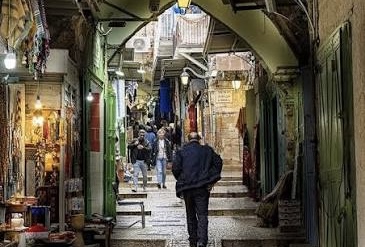
Occupied Jerusalem (QNN)- The Israeli government approved a plan on Sunday to confiscate Palestinian homes and shops along Chain Street, known locally as Bab al-Silsila Road, in the Old City of occupied Jerusalem. The move marks the first such large-scale expropriation in the area since 1967.
The decision confirms an order signed nearly 10 months ago by Israel’s heritage minister. It targets properties near the western side of Al-Aqsa Mosque compound and would lead to the expulsion of dozens of native Palestinians and shop owners.
According to the Palestinian Jerusalem Governorate, the plan aims to seize Palestinian-owned buildings in Bab al-Silsila neighborhood, one of the main historic roads leading to Al-Aqsa Mosque inside Jerusalem’s Old City.
Israeli Army Radio reported earlier this week that the street could soon become part of the so-called “Jewish Quarter” after the government vote. Israeli authorities described the move as part of efforts to strengthen Israeli "sovereignty" in the area.
The decision sparked deep concern among native Palestinians and traders, many of whom have lived and worked in the neighborhood for generations. The area sits only a few meters from Al-Aqsa Mosque and carries major religious, historical, and political significance.
Despite decades of Israeli settlement activity nearby, the neighborhood still maintains a strong Palestinian presence. Israeli police stations, settler outposts, and Al-Buraq Wall plaza already surround parts of the targeted area.
The Jerusalem Governorate described the plan as a “dangerous colonial escalation” that targets the heart of the Old City. It warned that the move could open the door to a new phase of forced displacement and tighter Israeli control over historic Palestinian property.
Officials stressed that Bab al-Silsila serves as one of the most important gateways to Al-Aqsa Mosque. They said targeting the area carries political and religious dimensions that go far beyond a property dispute.
Estimates indicate that between 15 and 20 shops and residential properties could face confiscation if authorities fully implement the plan.
The governorate said the move forms part of broader Israeli efforts to reshape the area around Al-Aqsa Mosque and reduce the Palestinian presence in the Old City. It stated that Israeli authorities are trying to transform the surrounding neighborhoods into a closed colonial space that serves settlers and restricts Palestinian and Muslim access.
Israeli Army Radio did not disclose the exact number of properties targeted or identify their owners. However, the area contains historic Palestinian properties dating back to the Ayyubid, Mamluk, and Ottoman eras.
Under the plan, the Israeli government would authorize the "Jerusalem Jewish Quarter Development Company" to carry out the confiscations and manage the seized properties.
Jerusalem maps and settlement expert Khalil Tafakji said the legal basis for the decision dates back to 1968, when Israel confiscated 116 dunams of land in Jerusalem’s Old City under the pretext of “public interest.”
Tafakji said the Jewish Quarter covered only five dunams before 1948, but expanded dramatically after years of confiscations. Today, it covers around 130 dunams and houses roughly 4,500 Jewish residents.
He added that Israeli authorities transferred many properties from private Palestinian ownership into state control before handing them over to Israeli settlers.
According to Tafakji, Israel did not expel all Palestinians living within the confiscated zone in 1968. Some front-line properties remained inhabited until now. He estimated that the latest decision could affect between 15 and 20 additional properties belonging to Jerusalemite families.
Several well-known Palestinian families already lost homes and property during previous expansion projects in the Jewish Quarter, including the Nammari, Ghoneim, Bsheiti, Jaouni, Alami, Sharaf, and Burqan families.
Researchers also warned that the targeted area includes major Islamic and historical landmarks from the Mamluk and Ottoman periods.
Jerusalem historian Ihab al-Jallad pointed to the Tashtamuriyya School, one of the Old City’s most important historic schools. The complex once included Quran teaching rooms, religious study halls, and the tomb of the Mamluk prince Tashtamur al-Ala’i and his son Ibrahim.
Today, parts of the building serve as shops and homes for Palestinian families. The ground floor currently houses the Supreme Islamic Council, headed by Sheikh Ekrima Sabri.
Al-Jallad said the area also historically included markets, inns, stairways, and charitable endowments linked to the Dome of the Rock and Al-Aqsa Mosque.
For Palestinians in Jerusalem, Bab al-Silsila represents more than a historic road lined with old homes and shops. It remains a living center of religious, social, and economic life connected directly to Al-Aqsa Mosque and the Old City’s traditional markets.
In recent years, the street also became a major gathering point for Palestinian worshippers and activists confronting Israeli settler incursions into Al-Aqsa Mosque under heavy police protection.
Residents fear that implementing the confiscation plan would bring more settlers into the area and further restrict Palestinian access to Al-Aqsa Mosque through increased Israeli security measures.
Sources: Al Jazeera, QNN