For Palestinians in Gaza, the Rafah crossing with Egypt has long been the sole link to the outside world, serving as a critical lifeline for the enclave.
Israeli forces occupied the Palestinian side of the crossing during the genocide in May 2024, destroying its buildings, preventing travel and causing a severe humanitarian crisis, especially for patients. They deployed soldiers in a military zone all across the Philadelphi Corridor, where they remain today.
The first phase of Trump’s Gaza ceasefire 20-point plan which took effect in October 2025 to end the assault had called for Israel to let humanitarian aid into the territory and open “the Rafah crossing in both directions”.
However, Israel reopened the crossing only in February, amid repeated unjustified closures, severely limited access, and strict restrictions and monitoring.
“Welcome to Hell”: The Journey to Home
Palestinians returning to Gaza through the Rafah border crossing have reported systematic harassment and beatings, saying Israeli forces told them to leave Gaza with their families and never return.
The returnees who spoke to Quds News Network described a long and exhausting journey back to their homeland, marked by fear and uncertainty.
Sana’a Dawood, an elderly woman, traveled with her grandchild to Egypt for medical treatment after being injured in an Israeli strike during the genocide in the Maghazi camp in central Gaza. Yasmeen Mohamed, a 22-year-old woman, fled the genocide with her family to Egypt.
According to the two returnees, the journey back involved passing through three separate checkpoints.
The first appeared to be on the Egyptian side, where officials urged travelers to remain in Gaza and reject any attempts at forced displacement. The two described the procedures there as routine: bags were searched, passports stamped, and travelers were allowed to continue toward Gaza.
The second point, inside the Karem Abu Salem Crossing, appeared to be staffed by European Union personnel alongside Palestinian-affiliated security members, reportedly linked to the Palestinian Authority. According to the returnees, the Palestinian personnel handled the inspections while the EU officials stood nearby observing. Travelers were told to be careful and wished for a safe journey.
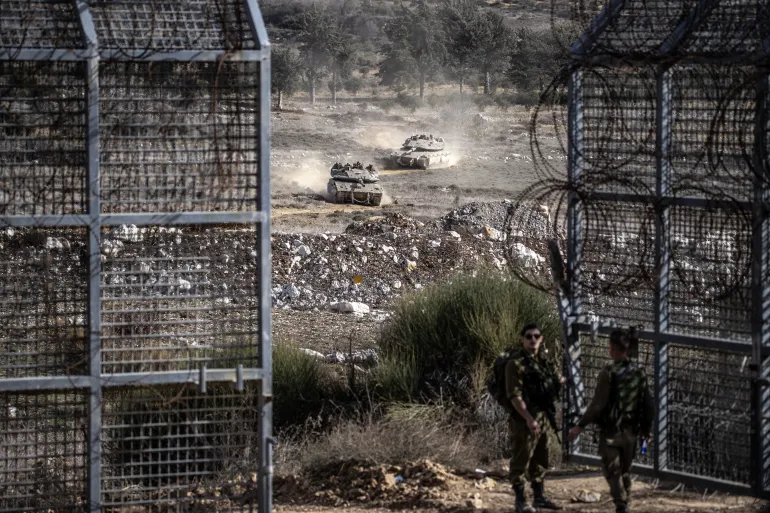
A photo of this point circulated widely on social media. The image showed the entrance to the crossing after two years of genocide: a narrow corridor lined with tall metal fences topped with coiled razor wire. At the far end, a large metal gate stands closed, blocking passage, as if it is a "caged road".
Palestinians condemned the fenced crossing, calling it a “gateway to an open-air prison.”
The two described this stage as “humiliating,” marked by constant surveillance and screening. Each traveler was processed individually: once an Israeli officer behind the screening system verified a person’s identity, a gate would open to allow passage one by one.
On the way to the third checkpoint, Israeli military vehicles escorted the buses carrying the returnees.
The third point, which the two returnees referred to as “hell”, was reportedly run by Israeli forces and members of Israeli-backed militias. According to their accounts, armed militia members received the travelers and searched them while Israeli soldiers watched from a distance.
The two said their passports, mobile phones, and electronic devices were confiscated and handed to the Israelis, while their belongings were left outside. They were then led into a makeshift structure wrapped in plastic sheeting and open from the top.
Sana’a said an Israeli female soldier entered the area shouting insults in anger. She said the soldier suddenly placed her hand on Sana’a’s private body parts in an act of intimidation. Another woman was then handcuffed and blindfolded before being taken for interrogation. The woman cried repeatedly, insisting she had no affiliation with any resistance group.
According to Sana’a, the woman later said that the Israelis and Israeli-backed militia members told her to tell Palestinians in Gaza to leave, warning that “there will be no Gaza within a few years.”
“Gaza belongs to Israel. We will take over Gaza,” they told her while she remained blindfolded and handcuffed.
“These were the most horrifying moments,” Yasmeen said, confirming the account. Although only one man from her group was taken for interrogation, she said another woman was rebuked for carrying her husband’s passport from Egypt after it had been issued by Palestinian Authority in the occupied West Bank and transferred to the Palestinian side in Egypt.
Yasmeen also said she heard a man on the same bus recount that the Israelis offered him a house and a salary outside Gaza in an attempt to recruit him as an informant.
“Then they asked me why I returned to the devastated Strip,” the man said. “I told them I returned to my family.”
According to Yasmeen, Israeli soldiers and militia members confiscated nearly all of the travelers’ belongings, allowing them to enter with only one mobile phone each. “It is our right to bring legal personal belongings into our own land.”
“They even took my facial cream and my mother’s hand clock,” Yasmeen said. “They are petty and only want to provoke us.”
Sana’a added that the Israelis confiscated her phone and smashed it into pieces.
According to the two returnees, this final checkpoint was located in the southern Gaza city of Rafah.
“I Still See the Clementine Tree, I Can Even Smell It”
Yasmeen, a resident of Rafah, expressed grief and shock as she saw her beloved city completely wiped out.
On the way to Khan Younis — the city north of Rafah — she witnessed widespread destruction. In some areas, there was nothing but rubble; in others, only sand remained. Elsewhere, a lone house stood stripped of its walls, barely still standing.
“I was shocked. I will never forget the first time I saw my city like this,” she told Quds News Network.
Rafah has been under Israeli military control since the invasion in May 2024. Once home to an estimated 275,000 residents, the city now lies largely in ruins. Israel controls the Morag Corridor, just north of Rafah, allowing it to isolate and occupy the city.
Yasmeen said that along the way, she recognized her neighborhood in the Khirbat Al-Adas area of Rafah. “I knew it because I’m familiar with the distance between the Rafah crossing and our neighborhood,” she said. “The entire area was leveled. There was only sand — no trees, no homes, no beautiful villas, not even the water well we dug in front of our house. I immediately remembered the clementine tree in our garden. I still see the clementine tree. I can even smell it.”
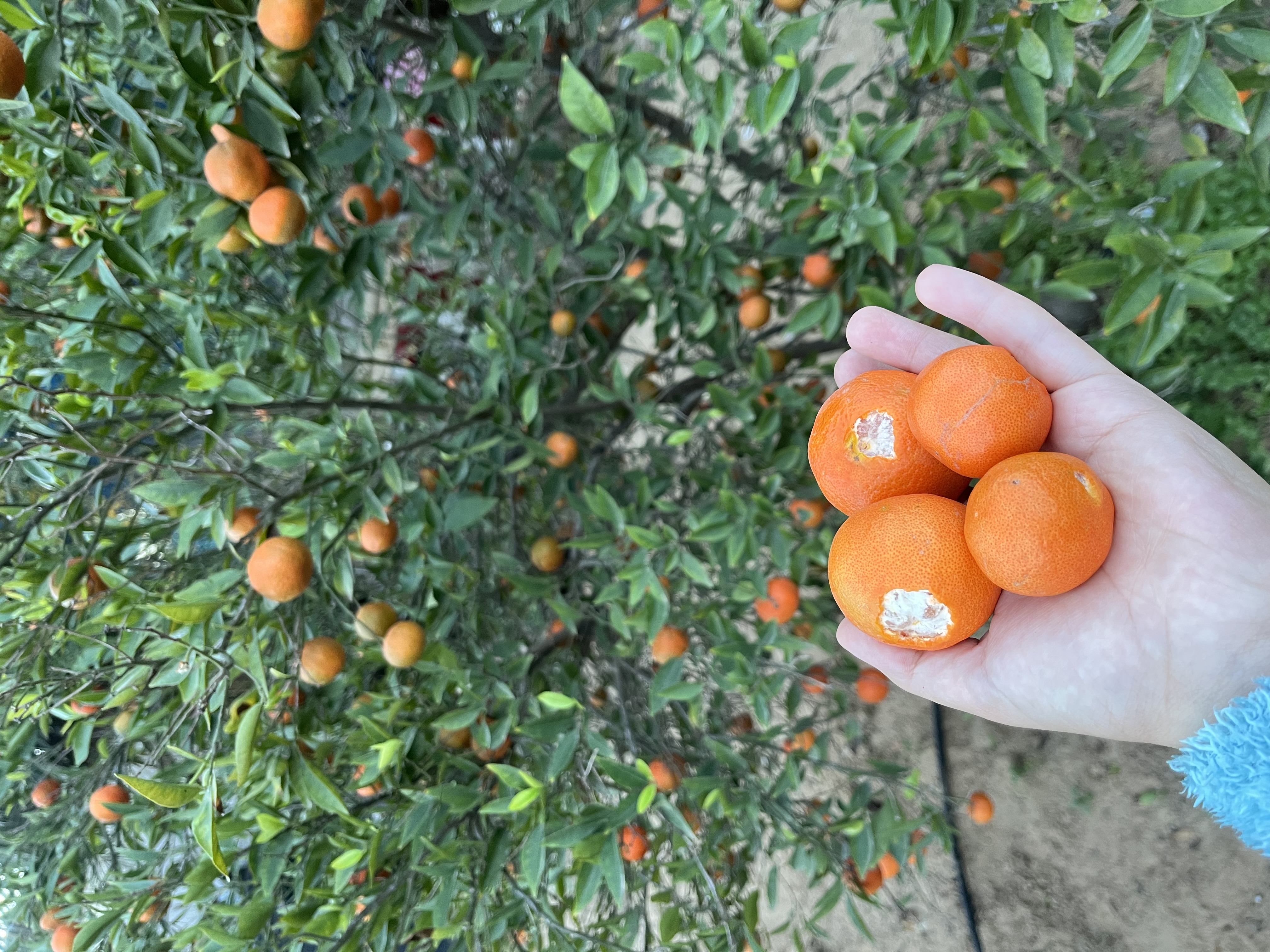 "The entire area was leveled. There was only sand — no trees, no homes, no beautiful villas"
Same Testimonies, Same Fate: “I Would Choose Gaza Every Time”
Following their arrival, travelers share their accounts with the media.
Over the course of an hour and 40 minutes, Sabah al-Rakab was subjected to “intense pressure” by two interrogators she could neither see nor identify. During the interrogation, the two played contrasting roles: one acted kindly, promising help, family reunification, housing, a salary, and a suitable life outside Gaza if she agreed to leave and never return; the other slammed the table, shouted, accused her of lying, and hurled insults she refused to repeat due to their nature.
https://x.com/dropsitenews/status/2018805699065606412?s=46&t=t_-JFgpXqgMIkVsuBfWELw
When al-Rakab denied their offer to leave Gaza and never come back, the two interrogators went back to hurling insults. She says she had been wearing a woolen shawl to protect herself from the cold, but that they took it from her. As she grew cold and began to cry, she told them she was sick and needed warmth. Instead of returning the shawl, they sprayed water on her back.
Another traveler, Taghreed Marouf, says that from 3 a.m. to 9 a.m., she was made to sit on a steel chair, hands cuffed and eyes blindfolded. Her feet were tied to the chair. They were asking about her husband, who serves as a policeman in the Hamas-run civilian branch of government in Gaza.
“They did not believe that he was a policeman. They kept insisting that he is a member of the Qassam Brigades,” she says. “I kept telling the interrogator that he isn’t affiliated with al-Qassam, and that he is only working as a civilian policeman to feed his family and has nothing to do with any military activity.”
Marouf says the interrogator then hit her with the butt of his rifle.
During the interrogation, they asked Marouf to provide information about another individual, but she denied any knowledge of the details they sought. After that, she says, they stripped her of her winter jacket and left her to sit in the cold for a few more hours.
“The interrogators asked me where I had surgery. I told him on my hip. He told me to turn my body so he can see. When I did, and he saw where they had operated on me, he hit me there with his rifle. He kept kicking me in the same spot. I fell down and lost consciousness. When I next opened my eyes, I was in a hospital in Gaza.”
Another traveler, Routana al-Rakab, was offered the chance to reunite with her family and children at the border before they all left together. She refused. They then offered to provide her with a place to live away from the rubble. She refused again, insisting that all she wanted was to return to Gaza. At that moment, the officer’s tone shifted, his “generosity” turning into rage. He began slamming his hands on the table, raising his voice, and threatening to deprive her of her children, saying she would never see them again.
“He said that ‘Gaza is ours — if not today, then in twenty years, in thirty years. We own Gaza now. Not a single Palestinian will remain. You will all leave, and it will belong to us,’” al-Rakab recounts.
“My family, my land, my home, my memories — everything I know and love can only be found in Gaza,” al-Rakab says. “I will never choose to leave without returning. It’s my homeland. Homeland is like the soul, it’s irreplaceable.”
“I lived in an occupation-free country,” she continues. “It’s really amazing to breathe freedom, but if it’s not in our homeland, then it’s not our freedom.”
Al-Rakab says that after over a year spent in Egypt, never felt safe or happy, despite not wanting for anything. “Exile is a burden, and home is a blessing,” she explains. “I choose Gaza every time.”
“They asked me to tell them what happens around me, what I see, and to do what they ask,” Sabah al-Rakab says.
“All of the questions revolved around why we wanted to return to Gaza. He told me Gaza has no life, that it’s completely destroyed and there’s nothing worth returning to. ‘Why do you want to go back?’ he’d say. And I would tell him: ‘I want to go to my family, to see my children and grandchildren. I want to see my family again.’” The interrogator then interjected to say that her husband was not in Gaza, but Oman. “He said, ‘I will send you to your husband in Oman. I will give you what you need and help reunite you with your children there. I will bring them and help them travel to Oman—on the condition that you never return to Gaza and that you turn back immediately.’”
Sabah refused, saying Gaza is her homeland. She added that she had lived in Egypt for more than a year and never felt comfortable or safe, and that she would only feel that way in Gaza.