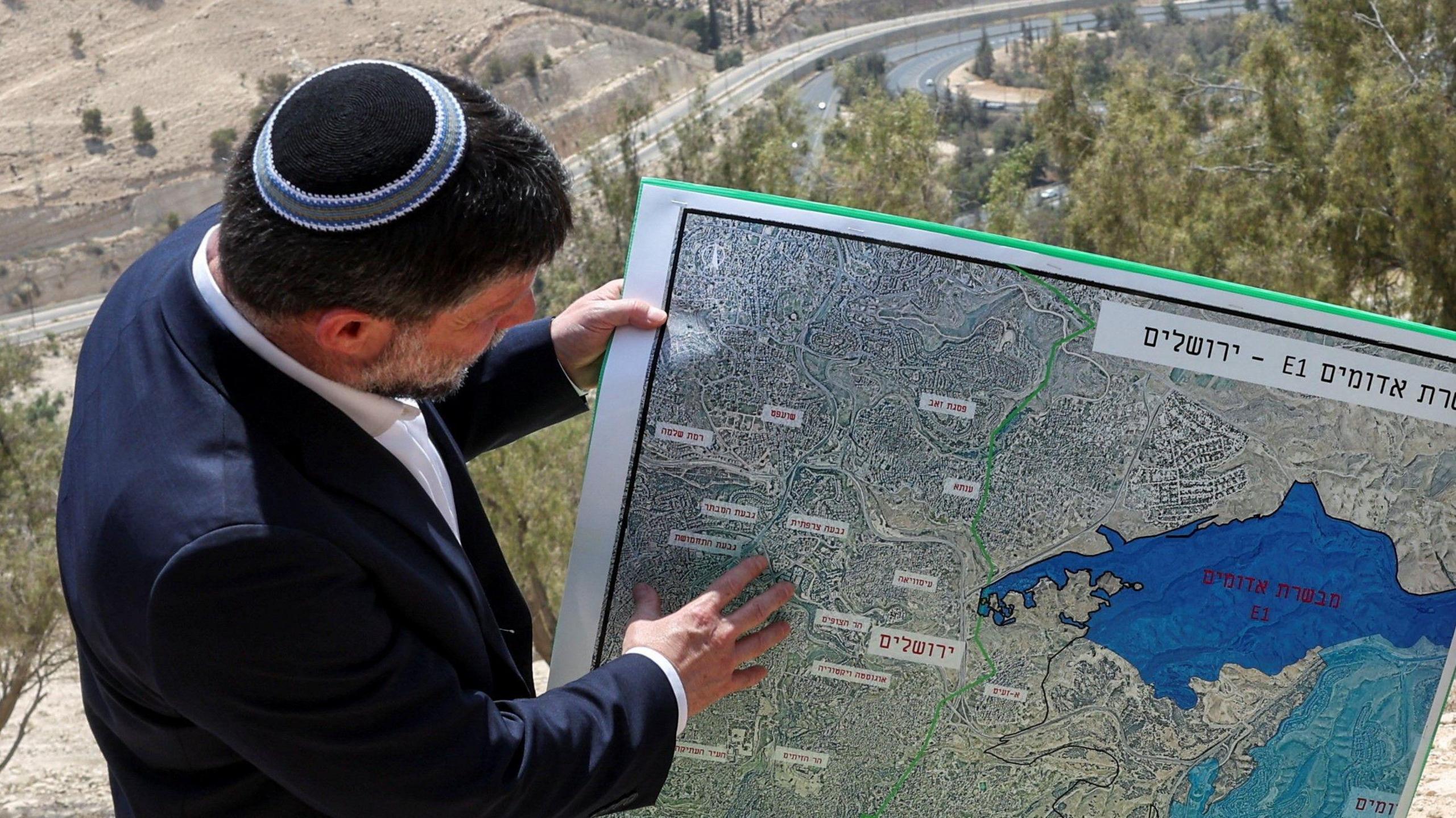
Occupied West Bank (QNN)- Far-right Israeli Finance Minister Bezalel Smotrich announced a plan to seize strategic lands in the occupied West Bank, in response to the European Union’s decision to impose sanctions on Israeli settlers and settler organizations over rising violence against Palestinians.
"I presented the Prime Minister with a plan to seize strategic areas in the West Bank in Areas A, B and C,” he said on X.
“European hypocrisy has reached new heights,” he said. “We will continue strengthening the settlements, deepening our roots in the Land of Israel.”
https://x.com/bezalelsm/status/2053866977408737446?s=46&t=t_-JFgpXqgMIkVsuBfWELw
The EU has agreed to impose sanctions on Israeli settlers and settler organizations over violence against Palestinians in the occupied West Bank. Consensus was reached on the sanctions packages at a meeting of member states’ foreign ministers on Monday.
The measures targeting Israeli settlers over violence against Palestinians in the West Bank were long-awaited, having been blocked by the government of Hungary’s former premier Viktor Orban.
That package targets three Israeli settlers and four settler organisations. However, their identities have not yet been publicly disclosed. It is reportedly understood not to include two extremist Israeli ministers, Itamar Ben-Gvir and Smotrich. The pair were put under UK sanctions last June for their “repeated incitements of violence against Palestinian communities”.
“It was high time we move from deadlock to delivery,” EU foreign policy chief Kaja Kallas said in a social media post following the agreement.
“Extremisms and violence carry consequences.”
Hungary’s former longtime Prime Minister Viktor Orban had blocked the sanctions for months.
However, the appointment of new PM Peter Magyar on Saturday saw the veto quickly lifted.
French Foreign Minister Jean-Noel Barrot welcomed the move, saying that the EU was “sanctioning the main Israeli organizations guilty of supporting the extremist and violent colonisation of the West Bank”.
“These most serious and intolerable acts must cease without delay,” he wrote on social media.
Be-Gvir denounced the EU as “antisemitic”.
“To expect the antisemitic union to make a moral decision is like expecting the sun to rise in the west. While our enemies perpetrate attacks and murder Jews, the European Union is trying to tie the hands of those who defend themselves,” Ben-Gvir said in a post on social media.
“The settlement enterprise will not be deterred. We will continue to build, to plant, to defend, and to settle throughout the entire land of Israel.”
The foreign ministers who met in Brussels discussed calls to ban products from Israeli settlements in the West Bank. Italy’s Antonio Tajani said that the European Commission would make a proposal on the move, and then the bloc would see if it had enough backing.
France and Sweden have called for tariffs on imported products from illegal settlements. “We believe that the EU urgently needs to increase the pressure on Israel to halt its settlement policy and practices,” the two countries wrote in a joint paper.
Sweden’s foreign minister, Maria Malmer Stenergard, said putting tariffs on products from illegal settlements was “the most realistic proposal”.
Banning products requires unanimity among the 27 member states, whereas tariffs can be imposed by a majority vote.
Barry Andrews, an Irish centrist MEP, who chairs the European parliament’s development committee, said EU foreign ministers had taken a “welcome (baby) step”. Writing on X he called for enforcement of labelling and banning of settler products, as well as ending research cooperation with Israel. He added: “Ultimately, only a review of the EU-Israel association agreement, with view to suspension, will have a major impact.”
More than 500,000 Israeli settlers live in the occupied West Bank in settlements, among some three million Palestinians. Settlements are illegal under international law.
In 2025, the expansion of Israeli settlements reached its highest level since at least 2017, when the United Nations began tracking data.
Since the start of Israel’s genocidal war on Gaza, there has been a spike in violence against Palestinians in the West Bank; the violence involves Israeli forces and settlers with more than 1,000 Palestinians have been killed, according to the UN.
Human rights organizations and campaigners have long called for the association agreement between the EU and Israel to be suspended, in light of Israel’s human rights abuses in Gaza.