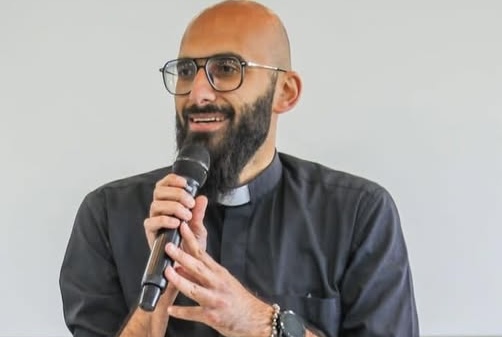
Occupied Palestine (QNN)- Israeli authorities have expelled Catholic priest Father Louis Salman from Palestine after refusing to renew his residency permit following a lengthy and unusual security investigation.
Father Louis led his final Mass on Sunday in the Palestinian town of Beit Sahour before departing for Jordan under Israeli orders. The emotional farewell drew wide reactions among Palestinian Christians and youth groups, who viewed the move as politically motivated.
The priest serves as pastor of the Latin Church in Beit Sahour and spiritual adviser to Palestinian Christian youth movements. He has become one of the most influential Christian figures among Palestinian youth in recent years because of his outspoken national positions and public presence during major Palestinian events.
Many Palestinians linked his forced departure to his support for Palestinian rights and his criticism of Israeli occupation policies.
Father Louis gained wider attention in 2022 after the killing of Palestinian-American journalist Shireen Abu Akleh. At the time, he organized and led a funeral prayer and procession for Abu Akleh in the northern West Bank city of Jenin before her funeral in occupied Jerusalem.
He was then serving as assistant priest in the town of Zababdeh.
Israeli authorities summoned Father Louis for an extensive security interrogation before informing him that he had to leave before May 11.
Palestinians and church figures described the decision as part of a broader Israeli campaign targeting Palestinian Christian clergy and institutions.
Earlier this year, Israeli authorities also forced Egyptian priest Father Youssef Asaad to leave after refusing to renew his residency. Father Youssef served as assistant priest at the Holy Family Church in Gaza.
Church officials say Israel has deported several foreign clergy members serving Palestinian churches in recent years under the pretext of residency and visa issues. However, many churches avoid publicly discussing the numbers out of fear of further retaliation against clergy members.
Rifat Kassis said Israel’s decision cannot be understood as an isolated administrative measure. He argued that it forms part of wider policies targeting Palestinians, including Christians.
Kassis said Israeli measures include restrictions on movement, land confiscation, revocation of residency rights, and pressure on Palestinian communities in Jerusalem and across the occupied territories.
He warned that recent Israeli actions increasingly target the Palestinian Christian presence itself.
According to Kassis, Christian churches and institutions play a major role in exposing Palestinian suffering internationally because of their global connections and influence. He said this has made them more vulnerable to Israeli pressure.
He also linked the case to growing pressure on predominantly Christian Palestinian towns such as Beit Jala, Taybeh, Aboud, and Birzeit through settlement expansion and increasing violence.
He said these policies appear designed to create conditions that push Palestinians, especially Palestinian Christians, toward forced migration.
Prominent Palestinian pastor Munther Isaac also condemned the move, writing: “My friend Fr Louis is being forced to leave Palestine. He is not the first Palestinian clergy to be exiled.”
Father Louis has repeatedly spoken publicly about the connection between Christian faith and Palestinian national identity.
During a Palestinian Christian youth event, he rejected claims that Christians cannot be both patriotic and faithful.
“Every Christian must be patriotic. This is not a choice,” he said.
“I do not belong to any political party, but I belong to this homeland, to Palestine. I belong to this land where I was raised and lived," he added.