
Ann Arbor, Michigan (QNN)- More than 1,000 faculty members, staff, and students at the University of Michigan have rallied in defense of academic freedom and pro-Palestinian student activism, calling on university leadership to reverse an apology issued after a commencement speech praised student protest movements.
The growing backlash reflects deep concern over a contradiction between the university’s stated commitment to free expression and its response to remarks supporting Palestinian solidarity.
By Monday afternoon, over 1,000 members of the university community had signed a letter urging President Domenico Grasso to withdraw his apology and reaffirm the institution’s principles of free speech and neutrality.
The letter calls on the administration to republish the full commencement recording and to uphold a 2024 policy that restricts university officials from taking positions on political issues unrelated to internal governance.
Signatories argue that the apology undermines those principles. They warn that selective enforcement of neutrality risks silencing viewpoints that challenge dominant narratives.
“Otherwise, we can only conclude that there is nothing neutral about the institution’s supposed commitment,” the letter states, stressing that freedom of expression must apply equally, even if there is pressure.
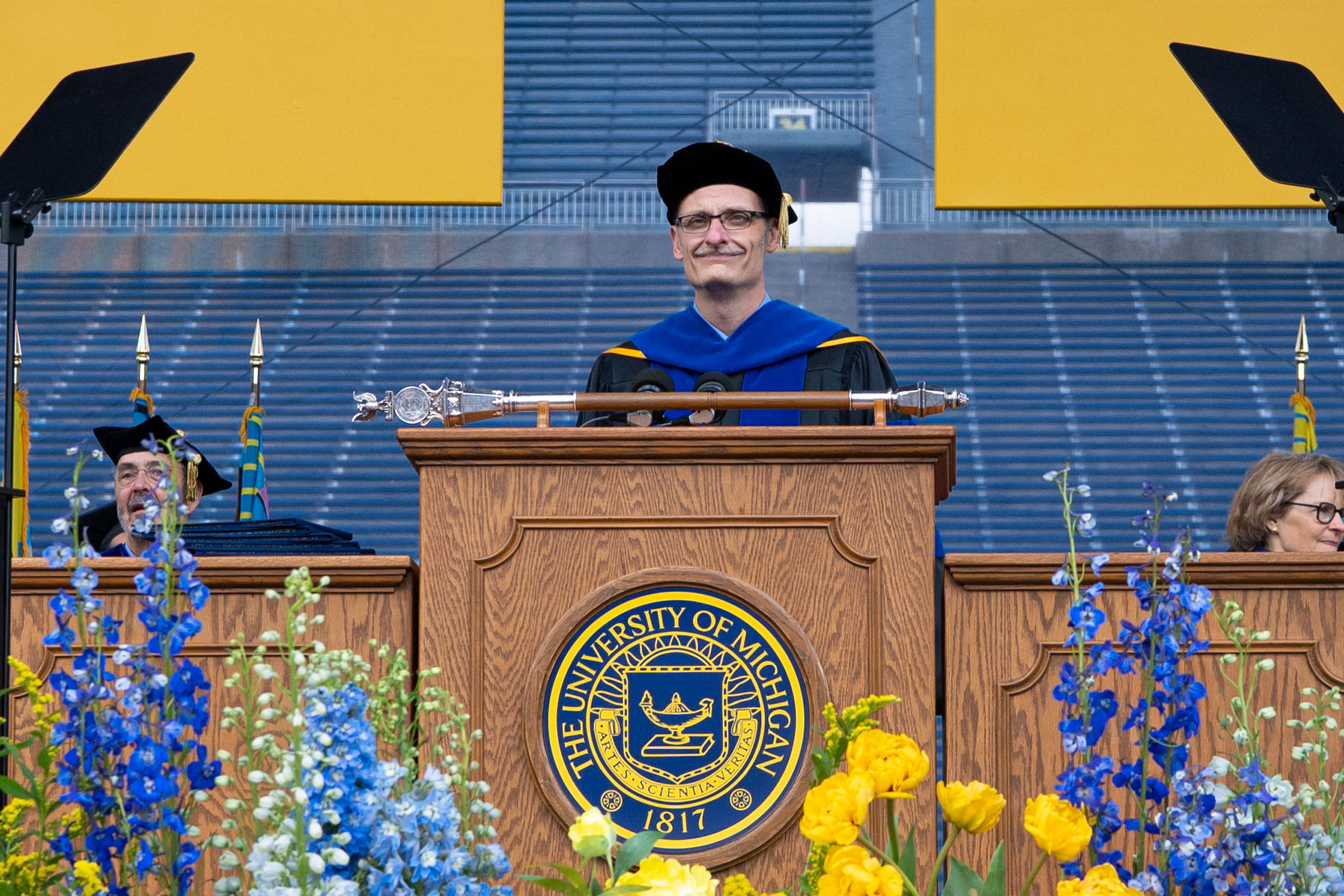
The controversy began during Saturday’s graduation ceremony in Ann Arbor, when Faculty Senate Chair Derek Peterson delivered a speech celebrating the university’s long history of student activism.
https://x.com/unseen_archive/status/2051062650193268818?s=46
Peterson highlighted figures who expanded access and fought injustice, including Sarah Burger, who challenged barriers to women’s admission, and Moritz Levi, the university’s first Jewish professor, who helped make the campus a refuge from antisemitism.
He then drew a connection to present-day activism, praising pro-Palestinian students for raising awareness about the genocide in Gaza.
“Sing for the pro-Palestinian student activists who have over these past two years opened our hearts to the injustice and inhumanity of Israel’s war in Gaza,” Peterson said, prompting applause from the audience.
He emphasized that the university’s strength lies not only in academic or athletic success, but also in the moral courage of its students.
“The greatness of this university rests also on the courage and the conviction of student activists who have pushed this university down the path towards justice,” he added.
Many faculty members have defended Peterson’s remarks as a principled and historically grounded reflection on the role of activism in shaping a more just society.
The faculty letter stated that Peterson’s speech fits squarely within the spirit of commencement; a moment to celebrate not only achievement, but also values such as empathy, courage, and social responsibility.
Signatories also note that Peterson’s comments were part of a broader narrative honoring generations of students who challenged inequality and expanded rights on campus.
Criticism of the speech emerged from zionist groups. President Grasso responded by issuing a public apology, describing the remarks as “hurtful and insensitive” and stating they did not reflect the university’s institutional position.
However, many faculty members say the apology itself crosses a line by taking a stance on a political issue, which they argue contradicts the university’s neutrality policy.
They also stress that the apology risks marginalizing members of the community who have been directly affected by the Israeli genocide in Gaza.
The letter highlights that many students and staff have experienced profound personal loss and displacement. For them, acknowledging the human impact of the genocide is not political rhetoric but a reflection of lived reality.
“Having an open heart to other people’s suffering is a fundamental human virtue,” Peterson said in a statement to the student newspaper, defending his remarks.
A parallel letter circulating among university alumni signals that the issue is expanding beyond campus, drawing attention from a wider academic and public audience.
Source: Bridge Michigan