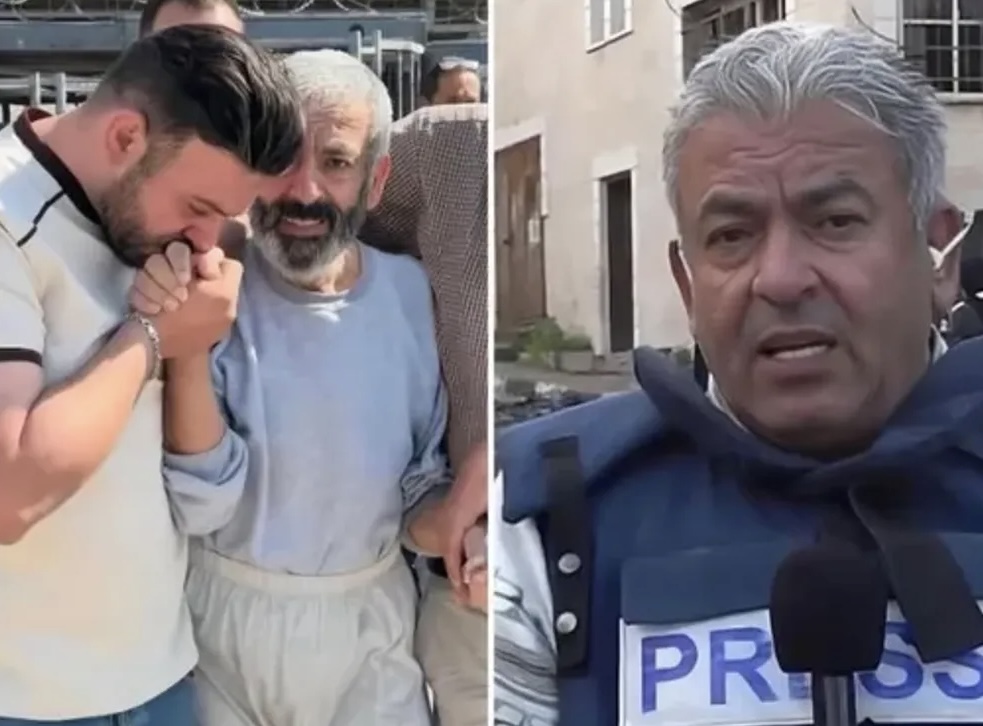
Occupied West Bank (QNN)- Veteran Palestinian journalist Ali Samoudi described Israeli prisons as “living graves” after his release on Thursday, appearing in severely deteriorated physical condition following his arrest by Israeli forces last year.
Samoudi, who worked for the Palestinian newspaper Al-Quds and international media outlets, said he lost 60 kilograms (about 132 pounds) while in Israeli prison. "My weight was 120 kilograms (about 264 pounds); now my weight is 60 kilograms," Samoudi said.
According to Samoudi, prison conditions were harsh and cruel, and prisoners suffered. "The food is very bad. Even a cat would not eat what they eat," he said. "Prisoners have nothing. No notebook, no pen, nothing," he added, calling on the families of detainees to take care of their well-being.
He was arrested in April 2025 on false claims of transferring funds to the Palestinian Islamic Jihad. Samoudi and his family strongly denied the allegations.
In a statement issued in January, the Palestinian Journalists Syndicate said al-Samoudi has not been granted a fair trial and that his arrest is “a blatant violation of international law and press freedom”.
The syndicate also warned “that his life is now at risk” due to the harsh and inhumane treatment he has been experiencing in prison.
Samoudi's son, Mohammed, said his father was an "independent journalist who isn't affiliated with any party," adding he was "surprised to hear him being accused of ties with Islamic Jihad. I was in shock."
Mohammed said the forces raided their home at around 5 A.M., searched the premises and destroyed some of the family's belongings before taking his father away. He said he didn't know where his father is being held, but said the family is particularly worried because he is diabetic and suffers from high blood pressure, and therefore needs a special diet and medications.
On May 8, 2025, Wafa reported that an Israeli court had issued an administrative detention order against him for a period of six months.
This was because the Israeli army said it did not have “sufficient evidence” to formally charge him and had hence issued an administrative detention order.
In a statement issued to the United States news group CNN, the Israeli army said: “As sufficient evidence was not found against him, and in light of the accumulated intelligence material, security authorities requested to consider issuing an administrative detention order.”
The military claimed the order was justified as Samoudi’s “presence” posed “a danger to the security of the region”.
Since then, Samoudi has been held in administrative detention and his detention order has been repeatedly renewed.
Samoudi also witnessed the Israeli killing of Al Jazeera journalist Shireen Abu Akleh in Jenin in 2022 and was himself injured that day.
"I was there personally and witnessed the whole thing," he said about the killing of his colleague. "There was no one there apart from the Israeli force, and they were the ones who shot at us."
The Palestinian Prisoners' Society said Samoudi is among more than 3,530 Palestinians held under administrative detention, in addition to over 40 journalists still held in Israeli prisons, including four women.
The group renewed calls for the release of all detained journalists and urged the international community to take responsibility for ongoing violations against prisoners.
More than 9,600 Palestinians remain in Israeli prisons, including women and children, facing torture, starvation and medical neglect, which have led to the deaths of dozens, according to Palestinian and Israeli rights groups.