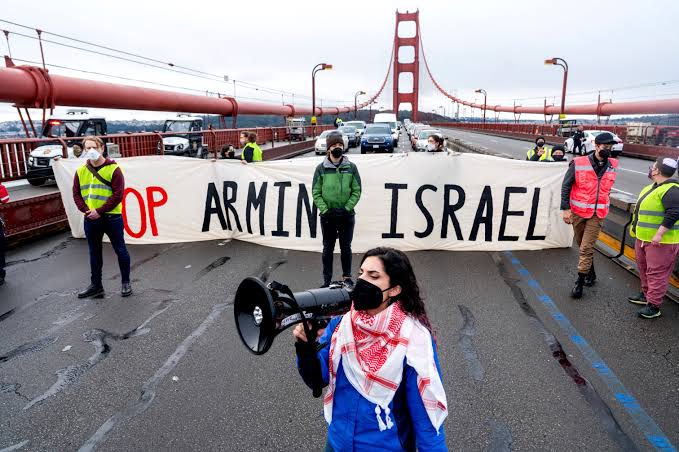
California (QNN)- Seven Bay Area activists will stand trial on Thursday, in a high-profile case linked to an anti-genocide protest on the Golden Gate Bridge. The defendants belong to the “Golden Gate 26,” a group arrested during a bridge protest on April 15, 2024. The jury trial will take place at the Civic Center Courthouse and is expected to last six to eight weeks, in a case widely described as highly politicized and marked by disproportionate charges and penalties.
Prosecutors, led by Brooke Jenkins, filed felony conspiracy charges against the seven defendants, alongside multiple misdemeanor counts. Authorities originally charged all 26 protesters with a total of 44 counts each, including dozens of false imprisonment charges. The case marked a rare escalation, as most previous bridge protests in the Bay Area typically resulted in minor infractions or dismissals rather than felony prosecutions.
Prosecutors initially sought nearly $200,000 in restitution, including claims from the Golden Gate Bridge Highway and Transportation District. However, the district later withdrew its financial claim after sustained legal challenges and public pressure. Despite this, judges denied repeated defense motions to reduce the felony charges, allowing the case to proceed to trial.
The protest aimed to demand an end to the US-backed Israeli genocide in Gaza. Demonstrators blocked traffic on the bridge, calling attention to the humanitarian crisis as global institutions reported mass massacres and widespread destruction in Gaza, especially during the first months of the war.
Defendants and their legal team stress that the charges reflect political bias and an effort to suppress dissent. Defense lawyer Shaffy Moeel described the protest as “an act of conscience,” stressing that participants sought to raise awareness about human suffering and to push for accountability. Co-defendant Sara Cantor said the prosecution sends a chilling message to those who protest government policies, warning that criminalizing solidarity risks undermining fundamental freedoms.
Manan Kocher, a co-defendant and press coordinator, told Quds News Network that authorities filed more than 900 combined charges against the group. He argued that prosecutors used restitution claims and felony charges to intimidate activists and discourage future protests. He also pointed to a pattern, noting that similar charges have targeted pro-Palestine demonstrators in previous bridge protests.
“Over at least the last 35 years, every Bay Area bridge protest has been handled as an infraction and/or ultimately dismissed, until our case,” he said, highlighting a departure from legal precedent.
Kocher further noted that DA Jenkins has taken a uniquely aggressive approach to Palestine-related protests. He said she is “the only local DA to charge bridge protestors with false imprisonment,” adding that both cases involved demonstrations in solidarity with Palestinians. “While we’ve been fighting charges of ‘false imprisonment,’ Palestinians in Gaza fight for their lives in an actual open-air prison,” he said.
Brooke Jenkins has shown clear bias in the handling of this case and other Palestine-related protests. She had called a rally calling for a ceasefire in Gaza as a “pro-Hamas rally". Reports also surfaced that senior staff in her office have expressed extreme racist anti-Palestinian views and that some met with pro-Israel lobbying groups, including the Jewish Community Relations Council. Jenkins’ office had also meetings with the Israeli Consulate, raising concerns about impartiality. In September 2024, the defense filed a motion to disqualify Jenkins and her office over bias, but the court rejected the request.
The case unfolds amid broader debates in the United States over protest rights, policing, and political expression. Activists say the trial could set a precedent for how authorities handle large-scale demonstrations, especially those tied to US wars and unlimited support for Israel.