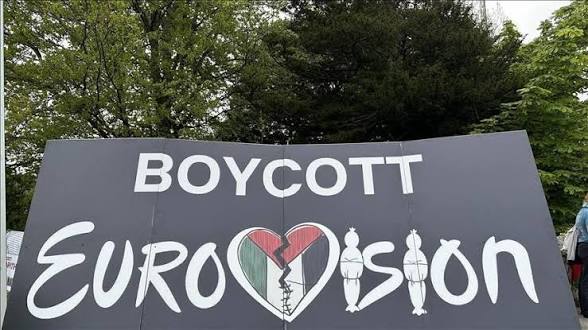
Vienna (QNN)- National broadcasters in Ireland, Spain and Slovenia will not air the Eurovision song contest this year, after they decided to boycott the event over Israel’s participation. Slovenia will instead show films about Palestine.
Having announced it would not submit a national entry, the Slovenian broadcaster RTV confirmed on Thursday it would implement a broadcasting blackout of the world’s largest live music event and instead show a series of films about Palestine.
“We will not be broadcasting the Eurovision song contest,” RTV Slovenia’s director, Ksenija Horvat, told the Associated Press. “We will be airing the film series Voices of Palestine, featuring Palestinian documentaries and feature films.”
Spain’s RTVE reiterated its decision not to air Eurovision last week, meaning the musical extravaganza will not be shown on Spanish television for the first time since the country started participating in 1961.
Ireland’s public broadcaster RTÉ announced last December it would neither broadcast nor participate in the event.
The Netherlands and Iceland also walked out of the event last December, but the contest will be shown on their respective national broadcasters, NPO and RÚV.
This year’s competition, Eurovision’s 70th anniversary, will have 35 competing countries and is scheduled to take place in Vienna, the Austrian capital, from 12 to 16 May.
The walk-outs were prompted by the decision of the organizing body, the European Broadcasting Union (EBU), to allow Israel to take part despite the genocide in Gaza.
Slovenia’s premier, Robert Golob, who was re-elected in a tight election this March, has been a vocal critic of Israel’s war. In August 2025 his government announced a ban on the import of products from Israeli settlements in the occupied West Bank as part of its response to “the Israeli government’s policy that undermines prospects for lasting peace”.
More than 1,100 musicians and cultural workers have signed an open letter calling for a boycott of the Eurovision Song Contest 2026 over Israel’s inclusion.
The signatories include Irish rap group Kneecap, Paloma Faith, Massive Attack, Paul Weller, Brian Eno, Peter Gabriel, Macklemore, and David Holmes. The campaign is coordinated by the group No Music For Genocide (NMFG).
The letter urged broadcasters, artists, crew members, and fans to refuse participation in the contest unless Israel is excluded. It also called on public broadcasters in Europe to withdraw, following recent decisions by Ireland, Iceland, Slovenia, the Netherlands, and Spain to step back from aspects of the competition.
This comes after months of growing calls to ban Israel’s participation in the contest over the genocide in Gaza where more than 72,000 Palestinians have been killed.
Spain, Ireland, Slovenia, Netherlands and most recently Iceland withdrew from this year’s contest.
The five countries had threatened to boycott this year’s edition of the glitzy music contest, due to be held in Vienna in May, if Israel took part, citing its genocidal war on Palestinians in Gaza – as well as confirmations that it unfairly intervened in the most recent competition to the benefit of its entrant in what reportedly was an attempt to politicise Eurovision.
The issue was initially supposed to be resolved with a vote in November 2024. But a few days after the announcement of a ceasefire agreement in Gaza on October 10, 2025 which Israel has violated repeatedly by killing hundreds of people and blocking the entry of much-needed aid, the EBU postponed the decision until its ordinary general assembly in Geneva.
Later, the contest’s organising body declined to expel Israel over the genocide. It said that it would instead introduce new rules “to reinforce trust and protect [the] neutrality” of the contest that would discourage governments from influencing the outcome.
That prompted the five countries to swiftly announce they would boycott the competition.
Russia was banned from competing in 2022 due to “the unprecedented crisis in Ukraine.” Critics and broadcasters, however, pointed to the ongoing genocide in Gaza and the West Bank under Israeli occupation.
The president of Slovenian broadcaster RTV noted that while the EBU banned Russia from Eurovision almost immediately after it invaded Ukraine in 2022, it "does not dare reject Israel".
In May that year, the EBU formally suspended its Russian members, indefinitely revoking their broadcasting and participation rights for future editions of Eurovision. Russia has not competed since.
RTÉ, the Irish broadcaster, said participation was “unconscionable given the appalling loss of lives in Gaza and the humanitarian crisis there” while RTVE in Spain said participating would engender “distrust” in the organisation given the depth of feeling over Gaza.
The Spanish broadcaster RTVE also said it would not broadcast the contest or the semi-finals in Vienna next year, describing the process of decision-making as “insufficient” and engendering “distrust”.
Spain’s Culture Minister, Ernest Urtasun, backed the boycott. He said: “You can’t whitewash Israel given the genocide in Gaza. Culture should be on the side of peace and justice. I’m proud of an RTVE that puts human rights before any economic interest.”
The Slovenian national broadcaster, RTVSLO – the first to threaten a boycott this summer – said participation “would conflict with its values of peace, equality and respect”. It said it was “on behalf of the 20,000 children who died” in Israel’s genocidal war on Palestinian people in Gaza.
Stefan Eiriksson, director-general of Icelandic national broadcaster RÚV, said: "There is no peace or joy connected to this contest as things stand now. On that basis, first and foremost, we are stepping back while the situation is as it is."
RÚV said Israel's participation had "created disunity among both members of the European Broadcasting Union (EBU) and the general public".
If the EBU fails to act, it risks a major split within Europe’s most-watched cultural event. For many broadcasters, the contest is no longer just about music, but about taking a stand on Gaza.
Over the past two years, Israel has faced objections to its participation in Eurovision not only by EBU members but also by contestants themselves.
In May 2025, more than 70 past Eurovision contestants released an open letter calling for the EBU to ban Israel from participating.
Embroiled in diplomatic tension, the contest’s organizers announced the contest will have 35 participants, the lowest ever participation since 2003.