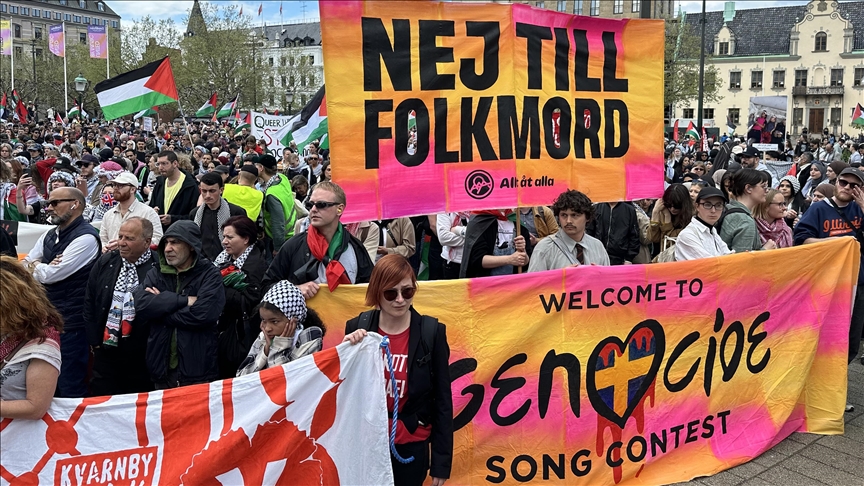
London (QNN)- More than 1,100 musicians and cultural workers have signed an open letter calling for a boycott of the Eurovision Song Contest 2026 over Israel’s inclusion.
The signatories include Irish rap group Kneecap, Paloma Faith, Massive Attack, Paul Weller, Brian Eno, Peter Gabriel, Macklemore, and David Holmes. The campaign is coordinated by the group No Music For Genocide (NMFG).
The letter urges broadcasters, artists, crew members, and fans to refuse participation in the contest unless Israel is excluded. It also calls on public broadcasters in Europe to withdraw, following recent decisions by Ireland, Iceland, Slovenia, the Netherlands, and Spain to step back from aspects of the competition.
The European Broadcasting Union (EBU), which organizes Eurovision, is condemned in the letter for applying double standards. The artists point to Russia’s ban from Eurovision in 2022 after its invasion of Ukraine and question why Israel remains included amid its ongoing genocide in Gaza.
The statement rejects Israel's genocide in Gaza and argues that Eurovision should not whitewash or normalize its actions. It also describes the EBU’s position as “hypocritical” and says the signatories “refuse to be silent.”
Massive Attack musician Robert Del Naja, who signed the letter, was recently arrested during a protest in London against the ban on Palestine Action.
Kneecap issued a strong statement alongside the campaign. The group said Russia was banned from Eurovision in 2022, while Israel continues to compete despite long-standing violence against native Palestinians. They said they have already faced consequences for their activism, including lost shows and legal pressure, but added they would continue speaking out.
“Silence is complicity,” the group said. They urged artists and broadcasters to reject the attempts to “whitewash genocide” and called for a Free Palestine.
NMFG organizers said Israel has participated in Eurovision for more than five decades while maintaining systems of occupation, apartheid, and violence against native Palestinians. They argued that cultural platforms should not ignore political realities.
The group also pointed to wider international boycott movements, including Palestinian cultural organizations, film workers in Hollywood, and labor actions in Europe, saying growing global resistance reflects a broader push to end complicity in Gaza.