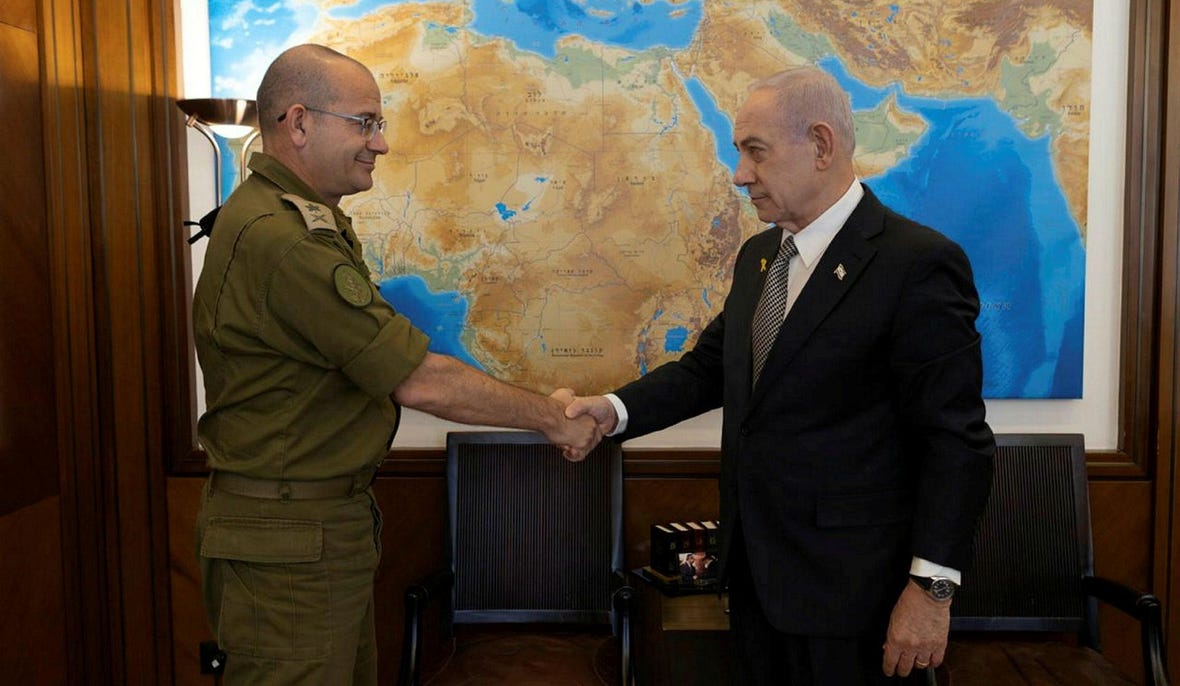
Occupied Palestine (QNN)- Israel’s incoming Mossad chief, Roman Gofman, is known for backing the occupation of the Gaza Strip and for using an Israeli teenager in an intelligence operation. He was approved on Sunday by Israel’s advisory committee on senior appointments and is set to begin a five-year term in June, replacing David Barnea.
Gofman, 49, was born in Belarus and immigrated to Israeli-occupied Palestine at the age of 14. He spent over three decades in the Israeli military Armored Corps, holding numerous command positions.
Here’s Everything You Need to Know About Gofman
Loyalty to Netanyahu and Misconduct Accusations
He has served as Netanyahu’s top military aide, and he was involved in all of the key strategic and operational decisions around the region over the past two years including in Iran, Lebanon, Gaza and Syria.
Gofman’s appointment by Netanyahu did not come as a surprise to many insiders, security sources previously told Walla.
Netanyahu announced his intention to appoint Gofman to the Mossad in December, choosing him over other candidates from within the spy agency. Though not unheard of in Israel, it is unusual to pick a spymaster from the military, not within the agency’s own ranks.
When Netanyahu appointed Gofman, he described him as an “outstanding, bold and creative officer who demonstrated out-of-the-box thinking and impressive resourcefulness throughout the war.”
Veteran defense analyst Amir Oren told CNN that Gofman has little to no experience in the specialized skills needed in the Mossad, including intelligence gathering, special operations, and liaising with other spy agencies. Oren described these as skills “in which one must be well versed for years and probably decades before daring to command others.”
Instead, Oren says that Gofman, who isn’t known to be an English speaker, was picked because of his loyalty to Netanyahu.
“There is a unanimous appraisal by serving as well as veteran military and security professionals that these appointments were not intended to benefit the security of Israel but rather help Netanyahu personally and politically,” Oren said.
The process of appointing Gofman, however, was delayed for months over misconduct accusations.
He was involved in the use of a 17-year-old Israeli in an intelligence operation in 2022. Gofman is reported to have instructed military intelligence to provide teenager Ori Elmakayes with sensitive information to publish on social media as part of an influence campaign targeting Iran, Hezbollah and Hamas.
The teenager was later detained by the security services for an extended period and accused of publishing classified material, until the indictment was dropped after it was revealed that his activity was authorized.
The Times of Israel has cited Goffman as saying he wasn’t aware of the person’s age at the time, and that he had only ordered that he be given non-classified information.
The teenager, now 21 years old, has become one of Gofman’s most vocal critics and has appealed to the Supreme Court against his appointment.
Asher Grunis, who opposed the appointment, said: “The use of a minor Israeli civilian constitutes an extremely serious flaw and raises a moral-ethical concern. It amounts to a breach of integrity”.
Outgoing Mossad chief Barnea has also objected to the appointment, describing Gofman’s actions in the Elmakayes case as those of “someone who abuses their power”.
Elmakayes himself, who has been outspoken in his opposition, criticised the decision following Sunday’s approval.
“Roman Gofman used me illegally and immediately afterwards disowned me, abandoned me and did not put an end to the ongoing nightmare I went through,” he wrote on X.
“Someone who abandoned a 17-year-old boy will also abandon Mossad agents,” he added.
As a young officer, Gofman attended Torah classes at the pre-military yeshiva Bnei David in the illegal settlement of Eli in the occupied West Bank. The institution is known for its right-wing views, including support for Jewish supremacy.
“It was there that I learned what ‘the eternity of Israel’ means,” Gofman said in a book titled More Jewish Than You.
Israeli newspaper Ma’ariv reported that Netanyahu places full trust in Gofman, assigning him wide-ranging responsibilities. It added that Gofman, who speaks Russian, has made several undisclosed visits to Russia, as Netanyahu seeks to maintain close ties with President Vladimir Putin.
Ma’ariv also said Gofman played a central role in discussions between Israel and Syria in January.
"Gofman is Netanyahu’s loyalist, his military secretary. When Netanyahu decides on the appointment, he chooses to emphasise his loyalty and discretion. This carries significant political explosive potential," Amos Harel, military affairs commentator at Haaretz, told 103FM radio.
Other media outlets and former Israeli security officials have voiced similar concerns, arguing that Gofman’s appointment forms part of a broader effort to place loyalists within the security establishment, following Netanyahu’s appointment of Shin Bet chief David Zini.
"Prime Minister Benjamin Netanyahu’s decision to appoint his military secretary, Major General Roman Gofman, as head of the Mossad is a continuation of his politicisation and takeover of the intelligence community and the security establishment," Yossi Melman, a military affairs commentator, said in December.
Melman warned that if the Supreme Court approves the appointment, “Netanyahu will be able to tick off another stronghold he has captured”.
Former army chief and opposition MP Gadi Eisenkot said senior positions were being handed out as rewards for loyalty and alignment with the prime minister’s agenda.
Rami Eigra, a former senior Mossad official, described the appointment as “politically motivated”, warning it could lead to fewer operational successes and potential failures.
According to Haaretz, Elmakayes and several Israeli NGOs are expected to petition the Supreme Court to block the appointment.
Views on Palestine, Gaza Genocide and Iran
During the subsequent of the genocide in Gaza, Gofman, who lived in the southern city of Ashdod, drafted a plan advocating the occupation of the entire Strip and recommending that Israel retain control after the war.
Shortly afterwards, Netanyahu appointed him as his military secretary in April 2024.
Gofman has previously criticized the army’s “avoidance of deploying ground forces”, saying: “We have a great deal to offer in the Gaza Strip, in Lebanon, and in Syria, wherever required.”
In February, he spoke at an event commemorating Orde Wingate, a British officer who served in Mandate Palestine, according to Israel Hayom.
Gofman praised Wingate, a Christian Zionist known for initiating brutal army tactics with Zionist forces against Palestinians.
“Decisive victory is the willingness and the capability to fundamentally change a situation,” Gofman said. “We used to believe there were those who could not be defeated, that it was beyond our power to fundamentally change reality. That is exactly what we have been doing over the past two years. Reality is changing.”
In 2019, during his higher education studies, Gofman suggested that Israel should sell nuclear warheads to Egypt, Saudi Arabia and Turkey as a way to counter Iran’s nuclear programme, according to Ynet.
Source: Haaretz, CNN, The Times of Israel