
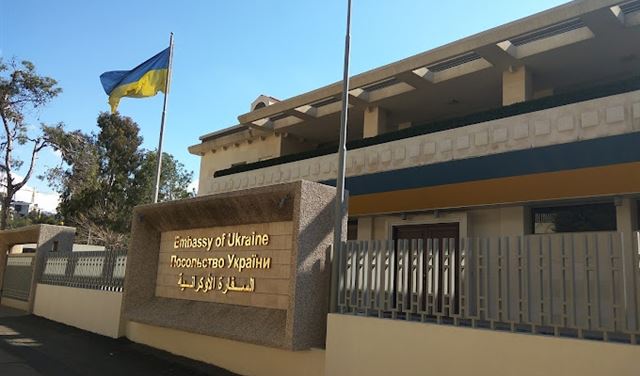
The Ukrainian Embassy in Lebanon is facing mounting scrutiny over sheltering an Israeli intelligence operative wanted in connection with multiple terrot attacks, as Lebanese authorities seek his arrest and efforts by the embassy to facilitate smuggeling him out from the country.
At the center of the controversy is Khaled Al-Aidi, a Palestinian-Syrian national holding Ukrainian citizenship, described as a high-level operative and head of a cell linked to Israeli intelligence.
Several Lebanese outlets across the political spectrum confirmed the reports.
Who is Khaled Al-Aidi?
According to investigations cited by journalist Radwan Mortada, Al-Aidi is wanted by both General Security and the Internal Security Forces. Investigators consider him one of the most significant Israeli agents detained in Lebanon in recent years.
Al-Aidi confessed during interrogation that he led a cell responsible for carrying out a series of operations, including planting explosive devices, planning mass-casualty attacks, and participating in an attempted assassination targeting a diplomatic figure at Beirut International Airport.
The same sources reveal that his activities extended beyond Lebanon, involving operations in multiple countries.
Lebanese security officials further believe that Al-Aidi may have been present in Beirut’s southern suburb on the day Hassan Nasrallah was killed in an Israeli airstrike in 2024, and may have contributed intelligence used in the attack.
Arrest and Plot
Hezbollah first detained Al-Aidi on September 27, 2025, according to Mortada, during heightened security preparations for a mass commemoration marking the anniversary of Nasrallah’s killing.
The arrest reportedly occurred after Al-Aidi parked a motorcycle near Airport Road, close to the planned gathering site. Hezbollah members who inspected the vehicle discovered an explosive device concealed in a battery-shaped container.
Officials believe the device was intended to be detonated during the event, which could have resulted in mass civilian casualties.
Following his arrest, investigators concluded that Al-Aidi was part of a broader network working with Israeli intelligence.
A Parallel Assassination Plot
In a separate case, Lebanese security sources cited by Mortada described the dismantling of another cell linked to assassination plans targeting Ali Larijani, the Secretary of Iran’s Supreme National Security Council, during a visit to Lebanon. Larijani was later killed in an Israeli airstrike in Tehran on March 17, 2026.
According to these accounts, members of the cell rented a VIP parking space at Beirut International Airport and planned to deploy a remotely operated weapon to carry out the attack. Authorities also reported the presence of explosive-laden motorcycles intended to create chaos during the operation.
Al-Aidi is believed by investigators to have been connected to this broader network, though the full extent of his role remains unclear.
Why Hezbollah Refused to Hand Him Over
Despite requests from Lebanese General Security to transfer Al-Aidi into state custody, Hezbollah reportedly refused.
The party's position appears rooted in previous incidents between 2023 and 2025, in which terrorists collaborating with Israel were handed over to Lebanese authorities but later released, reportedly due to their foreign citizenship.
Hezbollah officials viewed Al-Aidi as leverage in a potential prisoner exchange, particularly after Israel kidnapped at least 22 Lebanese citizens during the 2024–2025 Israeli war, many of whom remain unaccounted for.
Escape and Entry into the Ukrainian Embassy
Al-Aidi’s escape occurred following an Israeli airstrike on the building where he was being held in Beirut’s southern suburb. The strike caused structural damage that allowed him to flee amid the chaos.
He subsequently made his way to the Ukrainian Embassy in Beirut, where Lebanese authorities later determined he was being sheltered.
According to security officials, the embassy contacted General Security requesting travel documents for a Ukrainian national who had “lost his passport.” When authorities requested identification, the embassy provided photographs and passport details that matched Al-Aidi.
Lebanese security forces then placed the embassy under surveillance amid concerns that he could be smuggled out of the country.
Diplomatic Pressure
Mortada told QNN that the Ukrainian Embassy formally requested Lebanese authorities facilitate Al-Aidi’s safe departure, despite existing judicial orders requiring his arrest if he leaves embassy grounds.
He also said that US officials, including the CIA station chief in Beirut, sought to intervene to secure Al-Aidi’s exit, potentially through diplomatic channels or covert means.
The case has drawn comparisons to that of Amer Fakhoury, a former militia commander accused of torture during Israel’s occupation of southern Lebanon.
Fakhoury left Lebanon aboard a US military helicopter in 2020 despite ongoing legal proceedings, a move that sparked widespread outrage and raised questions about foreign interference in Lebanese judicial affairs.
Observers warn that Al-Aidi could follow a similar path if diplomatic pressure overrides legal processes.
QNN contacted the Ukrainian Embassy in Lebanon for comment on the reports and the reported presence of Al-Aidi inside its premises. The embassy did not respond.
Mortada also told QNN that his team attempted to contact the Embassy, they responded that they do not have any individual under the name of Khaled Al-Aidi inside, despite security sources confirming that he remains present inside the embassy.
As the situation unfolds, the case is emerging as a test of Lebanon’s ability to assert judicial authority in the face of diplomatic pressure.