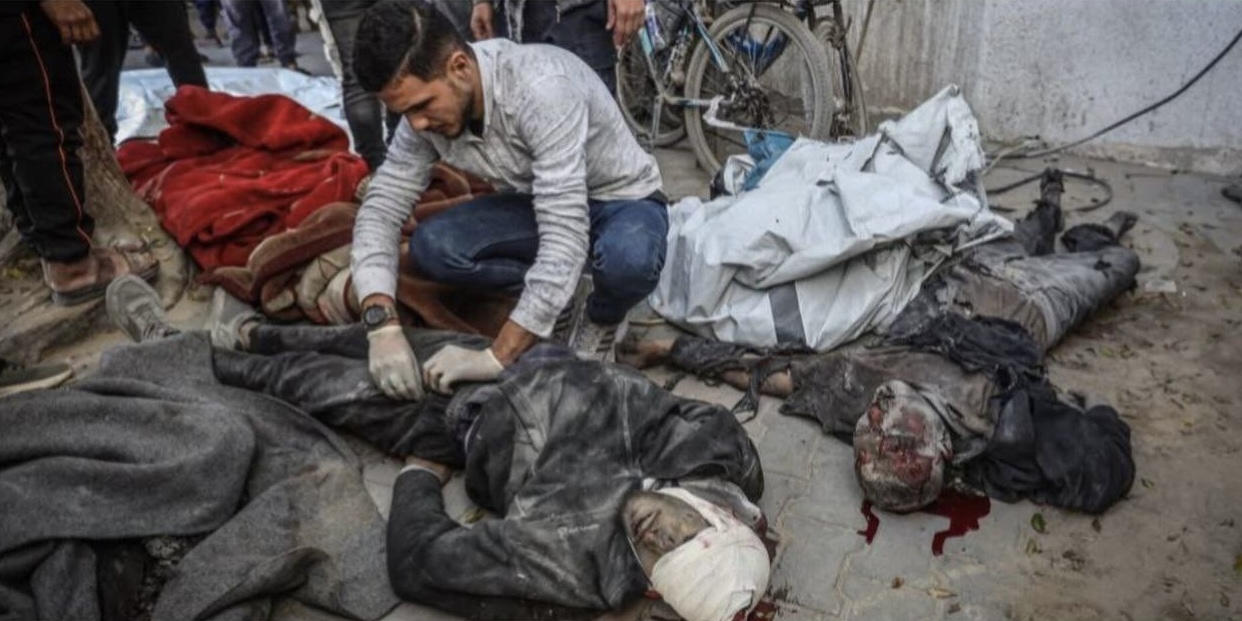
Israeli airstrikes killed 31 Palestinians across Gaza on Saturday, hitting a police headquarters, residential neighborhoods, and tents sheltering displaced families, as attacks intensified just as the ceasefire entered a critical new phase, raising urgent questions about the timing and purpose of the escalation.
The Israeli assault came as Israel was expected to implement key commitments under the ceasefire agreement, including opening crossings, allowing the entry of humanitarian aid, and facilitating the return of governance mechanisms to the Strip, while mediators continued efforts to move the deal toward its next phase amid mounting humanitarian pressure in Gaza.
Evading Obligations and Sabotaging the Deal
International relations expert Ali Abo Rezeq said the escalation reflects Israel’s attempt to escape its own obligations under the ceasefire agreement, after months of placing the burden entirely on the Palestinian side.
“Politically, Israel is trying to flee the phase of obligations,” Abo Rezeq said. “All previous stages imposed requirements on Palestinians, such as handing over prisoners and bodies, which Israel used to claim the Palestinian side was obstructing the deal.”
He explained that the situation changed once the agreement required Israel to open crossings, allow aid, withdraw forces, and begin reconstruction.
“When Israel’s turn came, it began sabotaging the agreement with all its force,” he said.
Genocide as a Goal
Abo Rezeq said Israel is also targeting early signs of recovery in Gaza, even when they take place under extreme humanitarian conditions.
“You build a camp, a school made of tents, or a clinic made of tents, like what happened in ‘Ghaith’ camp in Al-Mawasi,” he said. “This represents the possibility of recovery, even in a very harsh environment, and that directly contradicts the primary goal of genocide, which is to kill all hope for survival and life in Gaza.”
Rami Abdu, head of the Euro-Med Human Rights Monitor, said the Israeli army has committed “compound crimes” against Gaza’s population under fabricated justifications.
“The army of genocide has committed layered crimes since yesterday, claiming that fighters emerged from a tunnel in Rafah, even though the city is under full Israeli control,” Abdu said.
“This puts Israel, the world, and the mediators before one clear truth,” he added. “Israel gives no consideration to any agreement.”
Destroying Internal Order and Engineering Chaos
According to Abo Rezeq, Israel is deeply disturbed by the return of even limited internal order in Gaza, which explains the direct strike on the police headquarters in Sheikh Radwan.
“Israel is not upset about full security returning, but about any level of discipline,” he said. “That is why it bombed the police station, killing police officers, complainants, and prisoners at the same time.”
He added that Israel seeks to turn Gaza into a scene of internal chaos rather than a society with functioning institutions.
“The model Israel carefully planned is Gaza as internal guerrilla warfare, not a space with even minimal security control,” Abo Rezeq said.
Israeli journalist Elior Levy, speaking to Israel’s public broadcaster KAN, confirmed this assessment, saying Israel deliberately chose the police headquarters as a target.
“Israel selected the police headquarters in Gaza City as a target in response to Hamas deploying its forces across the Strip and seeking to escort the convoy of the new technocratic government,” Levy said.
Abo Rezeq also said Israel opposes coordination between Gaza’s national administration committee and the former government in the Strip.
“Some figures arriving through this government called for a consensual handover while benefiting from existing expertise,” he said. “This directly contradicts Israel’s plan to bring Gaza’s leadership on the back of an Israeli tank.”
Political analyst Ahmad Al-Heila said the sudden escalation serves multiple strategic goals tied to the next phase of the ceasefire.
“The surprise bombing and the killing of dozens aim to entrench the equation of Israel’s absolute military dominance,” Al-Heila said. “The army wants to kill and bomb freely while moving toward the second phase of the ceasefire.”
He said the strikes also seek to obstruct the work of the Palestinian national technocratic committee expected to enter Gaza via Rafah from Cairo.
“Targeting the police station is an act of engineering chaos and preventing internal security,” he said.
Forced Displacement
Beyond Gaza, Abo Rezeq said Israel is using the massacres to pressure Egypt into accepting large-scale displacement.
“Israel is not only pressuring Palestinians, but also Egypt,” he said. “It insists that if thousands leave Gaza, only hundreds should be allowed to return.”
He warned that this approach amounts to a slow forced displacement into Egypt and a long-term attempt to dismantle Palestinian political existence in Gaza.
Al-Heila added that the timing of the strikes sends a clear message to Palestinians.
“Bombing coincided with talk of opening Rafah,” he said. “The message is: leave Gaza with no return, because it is a land of death and unfit for life.”