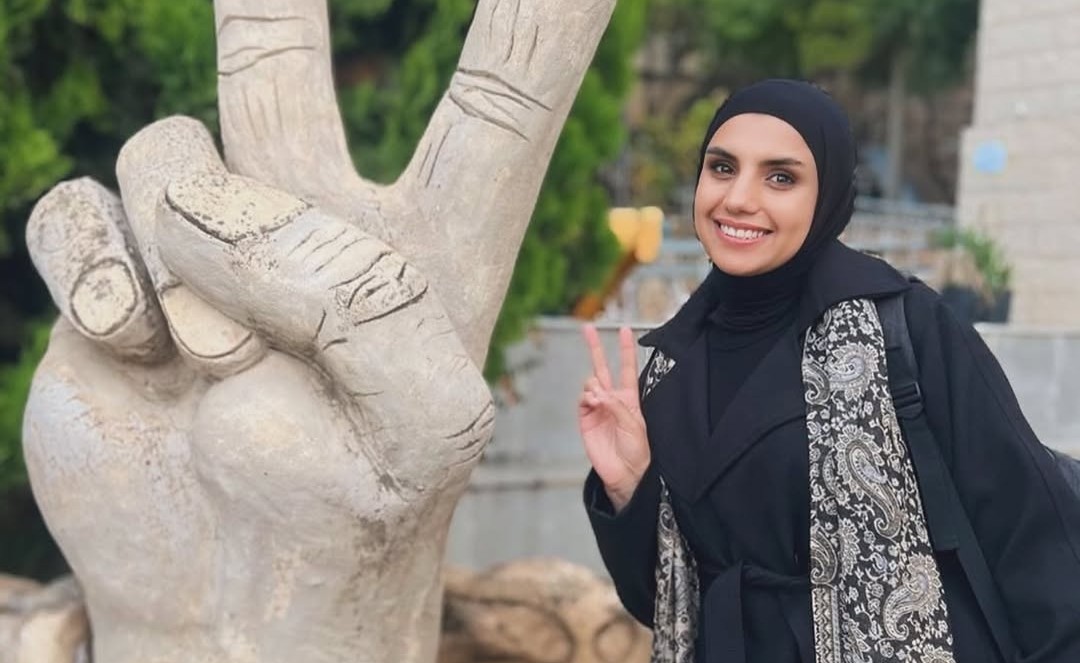
Occupied West Bank (QNN)- Released Palestinian journalist Inas Khlawi said she faced violations and abuse by Israeli soldiers following her detention earlier this month in the occupied West Bank. Israeli forces released Khlawi on January 15 after holding her for 11 days over social media posts.
Khlawi, who lives in the town of Idhna near occupied Hebron, said an Israeli military unit raided her family home in a violent night assault. She told Al Jazeera that soldiers smashed two doors, woke the entire family, and stormed the house while shouting. “We were asleep, then suddenly we woke up to breaking sounds and screaming. The soldier kept asking directly, ‘Where is Inas?’” she said, adding that soldiers forced her to hand over her phone before taking her away.
From the raid to interrogation, Khlawi said abuse began immediately. She reported that soldiers beat and insulted her inside the military vehicle before transferring her to the Tarqumiya crossing and then to interrogation centers. She said interrogators focused on her Facebook posts, most of which addressed the killing of Palestinian journalists Anas Al-Sharif and Ismail Al-Ghoul.
“My charge was how I published news about the killing of journalist Anas Al-Sharif, and why I described him as the face of Gaza,” Khlawi said. She explained that authorities labeled the post as incitement, even though the same content had circulated first in Israeli media. She said she challenged the judge in court and defended her work as a journalist trained in media for four years, stressing that expressing Palestinian reality always becomes “incitement” in the eyes of Israel.
Khlawi added that the court itself acknowledged, according to the translated decision, that the posts under investigation did not reach the level of incitement. Despite this, she said the detention continued under harsh conditions.
She also described undergoing a forced strip search despite her objections, calling it one of the most degrading experiences she has endured. “I felt my dignity was completely violated,” she said. “I refused at first, but the female soldier screamed and threatened to bring a male soldier to carry out the search. At that moment, I felt there was no escape.”
Khlawi said she spent two days in a cell, one of them without food. The meal provided the next day, she said, fell “below the level of human dignity.” She later transferred to Damon Prison, where prison authorities confiscated the clothes she wore during detainment and gave her only two pajamas without underwear. She also described dangerous cell conditions, including sharp metal edges under doors and the deliberate cutting of hot water during showers.
“In Damon, I understood for the first time that freedom is the most precious thing,” Khlawi said. “The experience was extremely harsh despite its short length. I felt as if the sky itself had changed while I was gone. I cannot imagine the suffering of women detainees who have spent years behind bars without charges.”
Israeli authorities released Khlawi on bail of 6,000 shekels, about $1,910, and ordered her to appear in court again early next month.