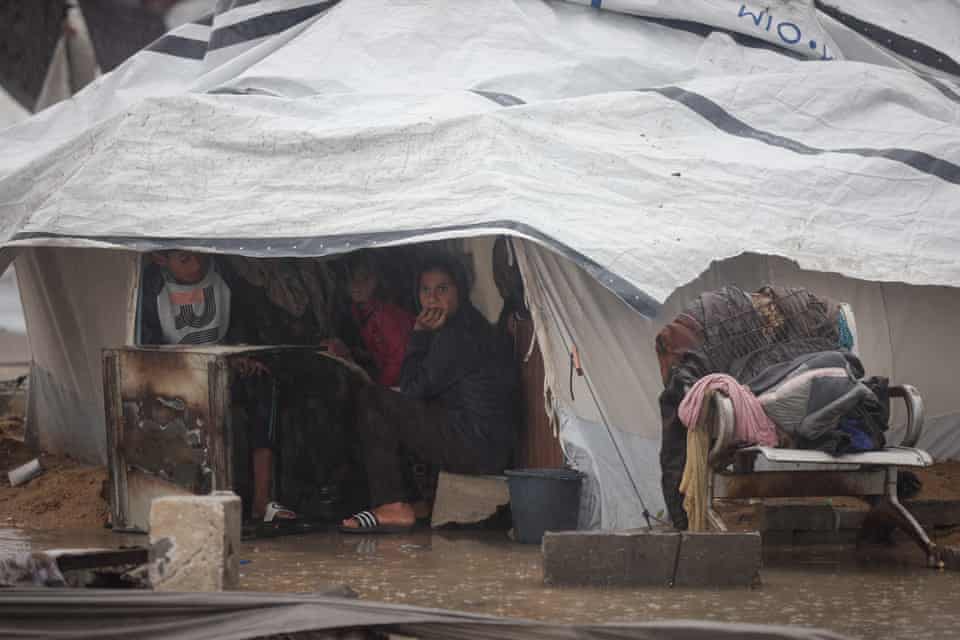
Gaza (QNN)- Tents supplied by China, Egypt and Saudi Arabia to shelter displaced Palestinians in the war-torn Gaza Strip are "inadequate for winter” and offer only limited protection, an assessment compiled by shelter specialists in the territory has found.
The assessment, prepared by the Palestine Shelter Cluster, which coordinates the activities of nearly 700 non-government organisations in Palestine and is chaired by the Norwegian Refugee Council, found that newly delivered tents housing hundreds of thousands of displaced Palestinians would “likely need to be replaced,” according to the Guardian.
The findings were based on 9,000 responses to a poll on social media in November, observations “from partners on the ground” and “community feedback.”
“The fabric [of the Egyptian tents] tears easily as sewing quality is poor,” it reported. “The fabric is not waterproof. Other issues include small windows, weak structure, no flooring, the roof collects water due to the design of the tent, and no mesh for openings.”
Saudi Arabia tents have “non-waterproof light fabric, weak structure” and tents donated by China were “very light” and not waterproof.
Those supplied by Qatar, the United Arab Emirates and the United Nations were judged to have met the specifications of UN experts, according to the assessment.
The findings come as more than 25 Palestinians, including babies, have died over the past weeks from hypothermia and collapsed buildings in Gaza as heavy winter rains and strong winds have brought new challenges to displaced Palestinians there.
Flimsy tents were flooded and blown out and makeshift camps engulfed in mud following heavy winter rains lashing the enclave.
Videos circulating on social media show tents being blown away, strong winds scattering belongings, displaced people pleading for help, and children shivering from the cold over the past days after a polar low-pressure system accompanied by heavy rain and strong winds battered the Strip.
More than 27,000 tents housing displaced families have been destroyed or swept away by flooding and powerful winds, affecting over 250,000 people across Gaza, the Gaza Civil Defense said.
Israel’s two-year war has destroyed more than 80 percent of the structures across Gaza, forcing hundreds of thousands of families to take refuge in flimsy tents or overcrowded makeshift shelters.
Now, the humanitarian conditions continue to deteriorate as winter deepens amid an Israeli blockade despite the ceasefire with limited access to shelter materials, fuel, and medical care.
Humanitarian groups have immediately urged Israel to allow unimpeded deliveries of aid to Gaza.
But the United Nations agency for Palestinian refugees, UNRWA, said the Israeli occupation government has blocked it from bringing aid directly into Gaza.
“People have reportedly died due to the collapse of damaged buildings where families were sheltering. Children have reportedly died from exposure to the cold,” UNRWA said.
“This must stop. Aid must be allowed in at scale, now.”
Israel has continued to kill Palestinians in Gaza and restricted the entry of much-needed aid, violating the ceasefire agreement.
“Entry of distribution and aid in the Gaza Strip will proceed without interference from the two parties through the United Nations and its agencies, and the Red Crescent, in addition to other international institutions not associated in any manner with either party,” Trump’s “20-point peace plan” says.
Last week, Israel said it will suspend more than three dozen humanitarian organisations, including Doctors Without Borders, for allegedly failing to meet its new rules for aid groups working in Gaza
https://x.com/tparsi/status/2006046521465115130?s=46&t=t_-JFgpXqgMIkVsuBfWELw
Organisations facing bans, started last Thursday, didn’t meet new requirements for sharing information on their staffs, funding and operations, Israeli occupation authorities said.
Other major organisations affected include the Norwegian Refugee Council, CARE International, the International Rescue Committee, and divisions of major charities such as Oxfam and Caritas.
International organisations said Israel’s rules are arbitrary. Israel claimed 37 groups working in Gaza didn’t have their permits renewed.
Israel changed its registration process for aid groups in March, which included a requirement to submit a list of staff, including Palestinians in Gaza.
Some aid groups said they didn’t submit a list of Palestinian staff for fear those employees would be targeted by Israel.
“It comes from a legal and safety perspective. In Gaza, we saw hundreds of aid workers get killed,” said Shaina Low, communications adviser for the Norwegian Refugee Council.
The Humanitarian Country Team (HCT), which coordinates decisions across UN agencies and NGOs working in Gaza and the occupied West Bank, urged Israel to reconsider its move, warning that they are an essential part of life-saving humanitarian operations in the occupied Palestinian territory.
“The deregistration of INGOs in Gaza will have a catastrophic impact on access to essential and basic services,” the HCT said in the statement.
“INGOs run or support the majority of field hospitals, primary healthcare centers, emergency shelter responses, water and sanitation services, nutrition stabilization centers for children with acute malnutrition, and critical mine action activities.”
The move comes as ten countries, including Canada and Britain, have expressed “serious concerns” over a “renewed deterioration of the humanitarian situation” in Gaza, describing conditions as “catastrophic” despite the ceasefire.
Recently, more than 100 aid groups accused Israel of obstructing life-saving aid from entering Gaza and called on it to end its “weaponisation of aid”.
The UN described Israel’s move as “outrageous”.
Ravina Shamdasani, the UN human rights spokesperson, said the move was the “latest in a pattern of unlawful restrictions” by Israel, as well as attacks on Israeli and Palestinian NGOs, amid broader access problems faced by the UN and other humanitarian groups.
Doctors Without Borders, also known by its French acronym MSF, warned that hundreds of thousands of Palestinians could lose access to essential medical care as Israel’s revocation of licences comes into effect.
“The Palestinian health system is decimated, essential infrastructure is destroyed, and people struggle to meet basic needs. People need more services, not less. If MSF and other INGOs lose access, hundreds of thousands of Palestinians would be cut off from essential care. We currently support one in five hospital beds and the delivery of one in three births in Gaza,” MSF said in a post on X.
https://x.com/msf/status/2006637463473971429?s=46&t=t_-JFgpXqgMIkVsuBfWELw
The Palestinian human rights group Al-Haq said the move amounts to an escalation of “genocidal policies” in Gaza.