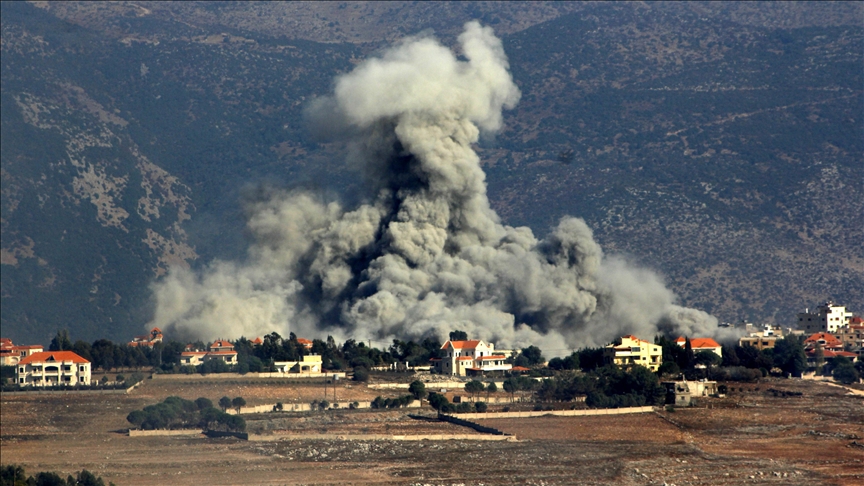
South Lebanon (QNN)- Israeli military is continuing the systematic destruction of villages in southern Lebanon during the ceasefire, including civilian homes, public buildings and schools as part of a broader policy to "clear the area” and prevent residents from returning like Gaza.
According to a report by Haaretz on Sunday, the Israeli military is continuing the systematic destruction of villages in southern Lebanon during a ceasefire, with military commanders telling Haaretz that civilian homes, public buildings and schools are being demolished as part of a broader policy to "clear the area."
They said dozens of heavy machinery vehicles, including excavators operated by paid contractors, have been brought into the area in recent weeks, with some workers compensated based on the number of structures destroyed.
A source familiar with the details said some contractors previously worked in Gaza, and in one village about 20 excavators are currently operating simultaneously.
Sources said the policy involves widespread demolition of civilian infrastructure and has been replicated from tactics used in the Gaza Strip during the genocide, now applied in Lebanon.
According to the sources, one of the goals of the plan is to prevent Lebanese residents from returning to areas along the border.
Last month, Defense Minister Israel Katz said that "all houses in villages near the Lebanese border will be demolished according to the model of Rafah and Beit Hanoun in Gaza,” two cities in Gaza that were wiped out during the genocide and now under Israeli control.
Katz added that the forces will be "positioned in a security zone inside Lebanon" and "will maintain security control over the entire area up to the Litani," even following the completion of its assault.
Now, the military is clearing buildings south of the so-called "Yellow Line," located about 20 kilometers south of the Litani River, beyond which Israeli forces are not permitted to cross under the so-called ceasefire agreement.
This line effectively marks the unofficial border reached by Israeli ground troops, from which systematic demolition of civilian infrastructure is being carried out.
The plan includes blocking residents from returning to at least 55 towns and villages within this zone while allowing Israeli forces to continue destroying civilians' houses calling them "Hezbollah-linked infrastructure."
According to reports cited by CNN, Israel aims to entrench a permanent field reality by establishing an emptied strip inside Lebanese territory. This approach relies on direct military presence and sustained firepower to limit any future civilian activity in the area.
Israeli military sources say forces now occupy around 55 towns and villages in southern Lebanon. Nearly 20 of these areas, especially those close to the front line, have suffered partial or near-total destruction.
On Tuesday, Haaretz reported that the military is establishing additional posts in southern Lebanon, a move that may indicate an intention for a prolonged presence in the area.
Israel’s far-right Minister of Finance Bezalel Smotrich also called for Israel’s official annexation of southern Lebanon, saying a “change of Israel’s borders” was necessary.
Lebanon was drawn into the US-Israeli assault, which started on February 18, on March 2 after Hezbollah launched attacks on Israel in retaliation for Israel’s killing of Iran’s Supreme Leader Ayatollah Ali Khamenei on the first day of the war, on February 28, as well as Israel’s near-daily violations of a ceasefire it agreed to in Lebanon in November 2024.
According to Lebanese authorities, Israeli attacks on Lebanon have killed more than 2,000 people since March 2 and displaced more than 1.2 million.
Netanyahu’s foreign policy adviser, Ophir Falk, threatened that Beirut’s Dahiyeh could "look like Gaza”.
Smotrich said that all of the southern suburbs of Beirut, one of the most densely populated areas near Beirut, will face devastation similar to Gaza during the genocide.
“Very soon, Dahiyeh will resemble Khan Younis,” Smotrich said, referring to a southern Gaza city that has been heavily damaged during Israel’s genocidal war on the enclave.
This approach mirrors a model Israel has used in the Gaza Strip, where it maintains extended control over large areas through both ground forces and long-range firepower. The aim is to enforce a lasting deterrence equation rather than rely on temporary ceasefire arrangements.
Amnesty International warned that the destruction of homes in southern Lebanon reflected Israel’s “record of atrocity crimes” in the Gaza Strip, where it has carried out a genocidal war against Palestinians since October 2023.
“The Israeli military has already extensively destroyed and devastated civilian life in southern Lebanon. The world must not stand by as Israeli leaders shamelessly threaten further destruction and displacement,” the rights group said in a post on X.
“Israel must not be allowed to violate international law with impunity across the region. World leaders must uphold their international legal obligations to halt Israel’s unlawful destruction of civilian property.
Medical Aid for Palestinians (MAP) said that Israel’s bombings and forced displacement orders for all of southern Lebanon and the southern suburbs of the capital, Beirut, “are instilling widespread fear among civilians”.
“What we are witnessing in Lebanon is the unmistakable extension of the Israeli military playbook used in Gaza,” said Steve Cutts, CEO of the UK-based charity.