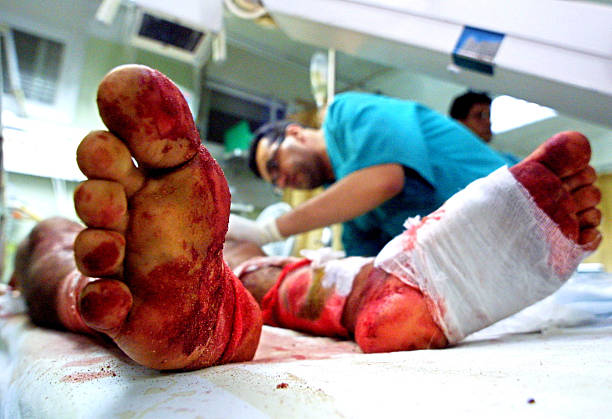
In the heart of Gaza, where human endurance is pushed to its limits, hospitals, once sanctuaries of healing, have become symbols of a health crisis. Beds are overcrowded, operating rooms function at reduced capacity, and doctors and nurses fight on the front lines of an impossible battle. Every hour tests their resilience.
Medical Blockade Strangles Gaza’s Survivors
Israel enforces a systematic policy restricting the entry of essential medicines and medical equipment. This blockade does more than threaten lives; it amplifies daily suffering and makes health care a tool of psychological and political pressure. The deprivation is not accidental. For years, it has been a deliberate, well-managed mechanism turning disease into a battleground.
Since the outbreak of Israel’s genocidal war, Gaza’s medical sector faces severe shortages. The Ministry of Health reports that 84% of critical medications are unavailable. Al-Shifa Hospital’s pharmacy director told QNN that anesthesia drugs and gauze are critically low. Alternative methods are being used, particularly in childbirth, increasing risks of lifelong disabilities for children.

Chronic Patients Hit Hardest by Equipment Shortages
Dialysis patients face life-threatening calcium deficiencies. Patients with Wilson’s disease cannot access zinc, essential to reduce toxic copper buildup, and even when available, costs are prohibitive. Children with diabetes struggle to manage blood sugar during famine-like conditions, where even bread is scarce.
Cancer treatment is also in crisis. Al-Shifa Hospital lacks standard chemotherapy protocols, and the March 2024 storming by the Israeli army damaged its CT scanner, forcing patients to travel elsewhere for procedures.
Zaher Al-Wahidi, Director of Gaza’s Information and Data Unit, reports severe shortages: 52% of medical devices, 71% of medical consumables, and 70% of laboratory equipment are unavailable. For chronic patients (diabetics, heart disease, kidney failure) 56% cannot access their medication regularly.
MRI machines are nonexistent. CT scanners are reduced from 17 to 7. X-ray devices dropped from 75 to 22. Over 55% of lab devices are destroyed. Blood and chemistry tests are halted, and primary care diagnostics are crippled.
Dr. Nasser Radwan, Head of Surgery, told QNN that patients with tumors, gastrointestinal bleeding, heart attacks, and kidney failure are most vulnerable. Shortages of catheters, stents, intravenous nutrition, and cancer treatments leave some patients with only prayer as hope.

A Paradox of Priorities
While medical essentials are blocked, Gaza sees an influx of electronic devices and smartphones. Dr. Munir Al-Barsh, Health Ministry Director, said, “Israel floods the Strip with luxury items, while blocking essential medicines, IV fluids, antibiotics, dialysis machines, and surgical supplies.”
Meanwhile, approximately 19,500 patients await permission to travel abroad for treatment. Only 50–100 are allowed out each month. So far, 1,122 patients have died due to travel restrictions—including 155 children, 166 women, and 300 elderly patients. Among the waiting are 500 children with urgent medical needs.
The human cost of Gaza’s healthcare collapse is painfully visible in the lives of individual patients. E.A., a woman in her 40s living with chronic diabetes, endured a slow but devastating decline in her health. Before the genocide, she managed her condition with regular medications and eye drops to prevent complications. But as the genocide intensified, these essential medicines became scarce and prohibitively expensive. Over time, her vision deteriorated, and despite her efforts to maintain her health, she ultimately lost her sight completely; a stark illustration of how shortages of basic medical supplies turn manageable conditions into life-altering disabilities.
"Before the war, I could see a little, enough to try to manage on my own”, she told QNN. “But then, I lost my sight completely. I can’t take two steps without one of my daughters guiding me."
Similarly, Um Isaaq, a long-time kidney patient, faced repeated displacements from northern to southern Gaza City. She often had to walk long distances just to reach hospitals, navigating streets made dangerous by the ongoing Israeli genocide. When she finally arrived, overcrowding and equipment shortages meant dialysis sessions were delayed by a week or more, causing dangerous buildups of toxins in her body. The scarcity of essential medicines and blood-strengthening treatments further worsened her condition. Ultimately, the relentless combination of displacement, delayed care, and medicine shortages led to her death.
These stories are not isolated incidents; they represent thousands of Gazans whose lives are imperiled simply because the medicines and medical equipment they need cannot reach them. For many, the right to treatment, once taken for granted, has become an unattainable dream.
Gaza’s healthcare system, already fragile, is weaponized by Israel. By controlling the flow of medicines and equipment, Israel turns the most basic human right; access to treatment, into a distant dream. The suffering is not incidental; it is a calculated strategy to control civilians, creating persistent fear, frustration, and despair.