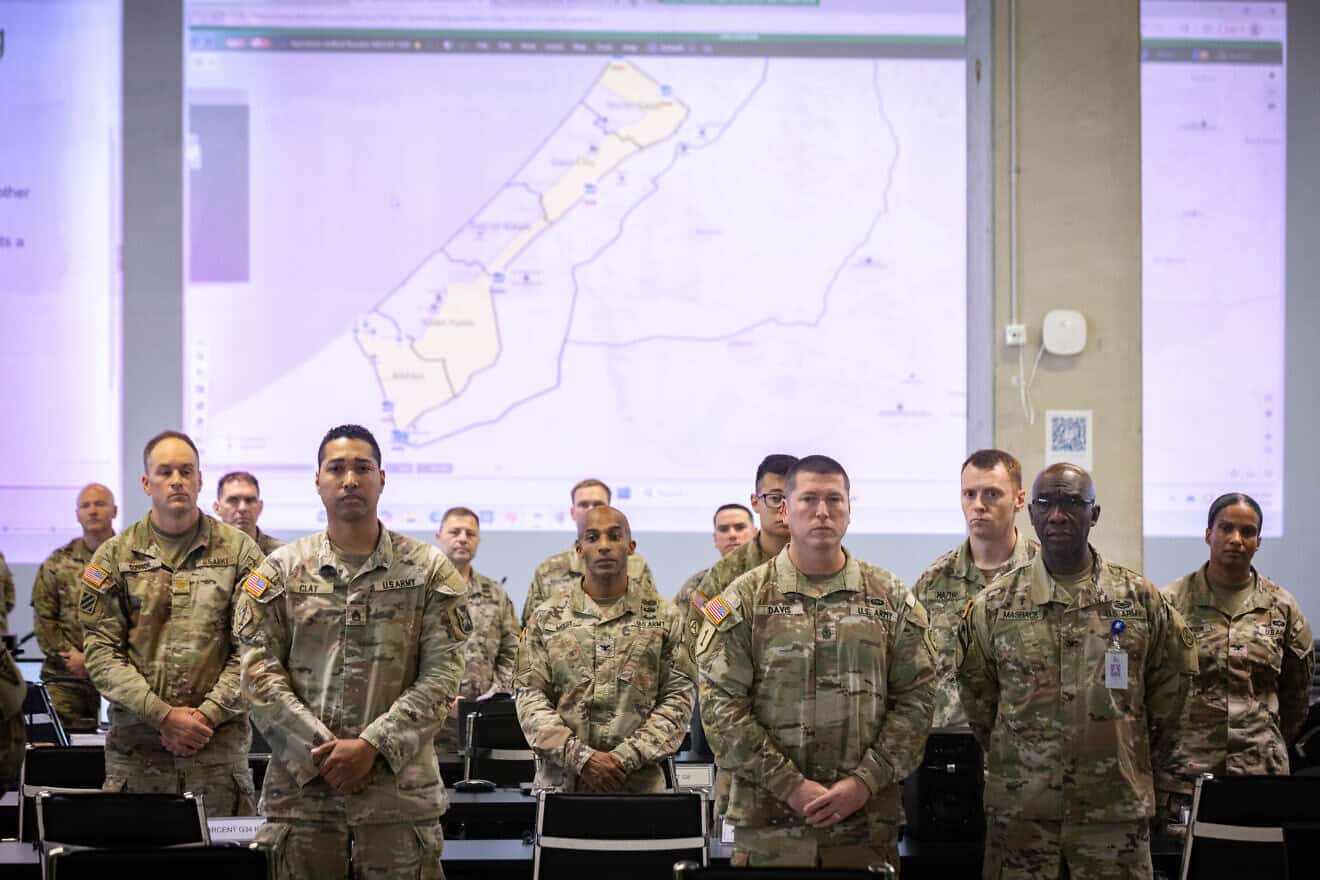
Occupied Palestine (QNN)- Israeli agents carried out wide surveillance on US forces stationed at the Civil-Military Coordination Center (CMCC), which monitors the Gaza ceasefire, according to a report by The Guardian. The leaks say US commander Patrick Frank summoned his Israeli counterpart and told him, “The recording has to stop here.” The meeting came after Israel collected intelligence on American personnel working inside the CMCC.
Officials and visitors from other countries raised concerns that Israel was recording inside the center. Some were warned not to share sensitive information because it could be captured and exploited. The United States Army declined to comment on the surveillance reports, and the Israeli military also refused to comment on the request to stop recording, saying discussions inside the center were not classified.
The CMCC was created in October to monitor the ceasefire, coordinate aid, and plan Gaza’s future under a 20-point plan linked to Donald Trump. It operates inside a multi-story building in the industrial zone of Kiryat Gat settlement, about 20 kilometers from Gaza. During this period, Israel continued to restrict food, medicine, and humanitarian shipments. The full blockade created famine in Gaza.
When the center began operating, some US and Israeli outlets suggested Israel had handed authority over aid-entry decisions to Washington. But two months after the ceasefire, a US official said Israel still controlled Gaza’s perimeter and the flow of goods.
The CMCC includes disaster-relief experts and logistics teams from the US, many of whom arrived motivated to open new supply routes. They soon discovered that Israeli restrictions, rather than engineering obstacles, blocked their work. Dozens left within weeks. Diplomats said internal discussions helped pressure Israel to adjust some banned-items lists, including tent poles and water-purification chemicals. But other basic goods, such as pens and paper needed to restart schools, remained prohibited without explanation.
The center brings together military planners from the US, Israel, the United Kingdom, and the United Arab Emirates. No Palestinian humanitarian or civil organizations are represented, and the Palestinian Authority is also excluded. Attempts to include Palestinians via video calls were repeatedly cut off by Israeli officials, according to the report. US planning documents avoided using the words “Palestine” or “Palestinians,” referring instead to “Gazans.”
Diplomats and aid workers inside the CMCC expressed deep concern about remaining involved. They fear the center could violate international law, exclude Palestinians from shaping their own future, and operate without a clear international mandate. They also worry that withdrawing would leave decisions about Gaza entirely in the hands of Israel and US military planners who have limited knowledge of Palestine or the broader political context.