UK Urges Israel to “Allow Much More Aid” Into Gaza Amid Restrictions Despite Ceasefire
London (QNN)- The UK Foreign Secretary has urged Israel to “allow much more aid” into Gaza and to “open all routes and crossings immediately,” amid Israeli restrictions on aid despite the ceasefire, with a consignment of over 1,100 tents sent by the UK to the war-torn strip took more than a year to arrive.
The Foreign Office announced that more than 1,000 tents reached Gaza on Monday following months of delay.
Yvette Cooper said: "The situation in Gaza remains dire, with worsening weather conditions compounding the critical issues caused by damaged infrastructure and over two years” of Israeli genocide.
"Parents have been trying to shelter their children under broken roofs and open skies. These tents will provide a lifeline to thousands of people needing shelter, protecting them from the cold winds and relentless rain turning rubble into mud."
Cooper said the arrival of the aid was welcome but only a step towards the major reconstruction that is "badly needed" and she was frustrated to see "yet another consignment of aid stuck at the border" earlier this year.
This cannot be allowed to continue," she said.
"The arrival of these tents shows the scale of potential impact when our aid gets in, and we will continue to do all we can to urge unhindered humanitarian access, the opening of all the crossings, the implementation of the peace plan, and a path to peace."
UNICEF Special Representative to the State of Palestine Jonathan Veitch said the arrival of the tents "represents months of ongoing work by the international community to push for greater aid access".
"The situation in Gaza is devastating as cold, and heavy rains continue to affect families living in extremely difficult conditions.”
"Even with the ceasefire, daily life remains incredibly challenging for children in Gaza.. much more is needed."
According to the UN on Monday, shelter needs in Gaza are “still high, with some 1.5 million people in need of urgent support.”
Cooper’s announcement comes amid repeated calls from human rights groups and protesters for the British government to end its complicity in Israel’s genocide in Gaza, as it provides vital components of F-35 jets and operates Shadow R1 surveillance flights over the war-torn enclave.
Three Winters Without Shelter, Gaza’s Families Face the Cold Again
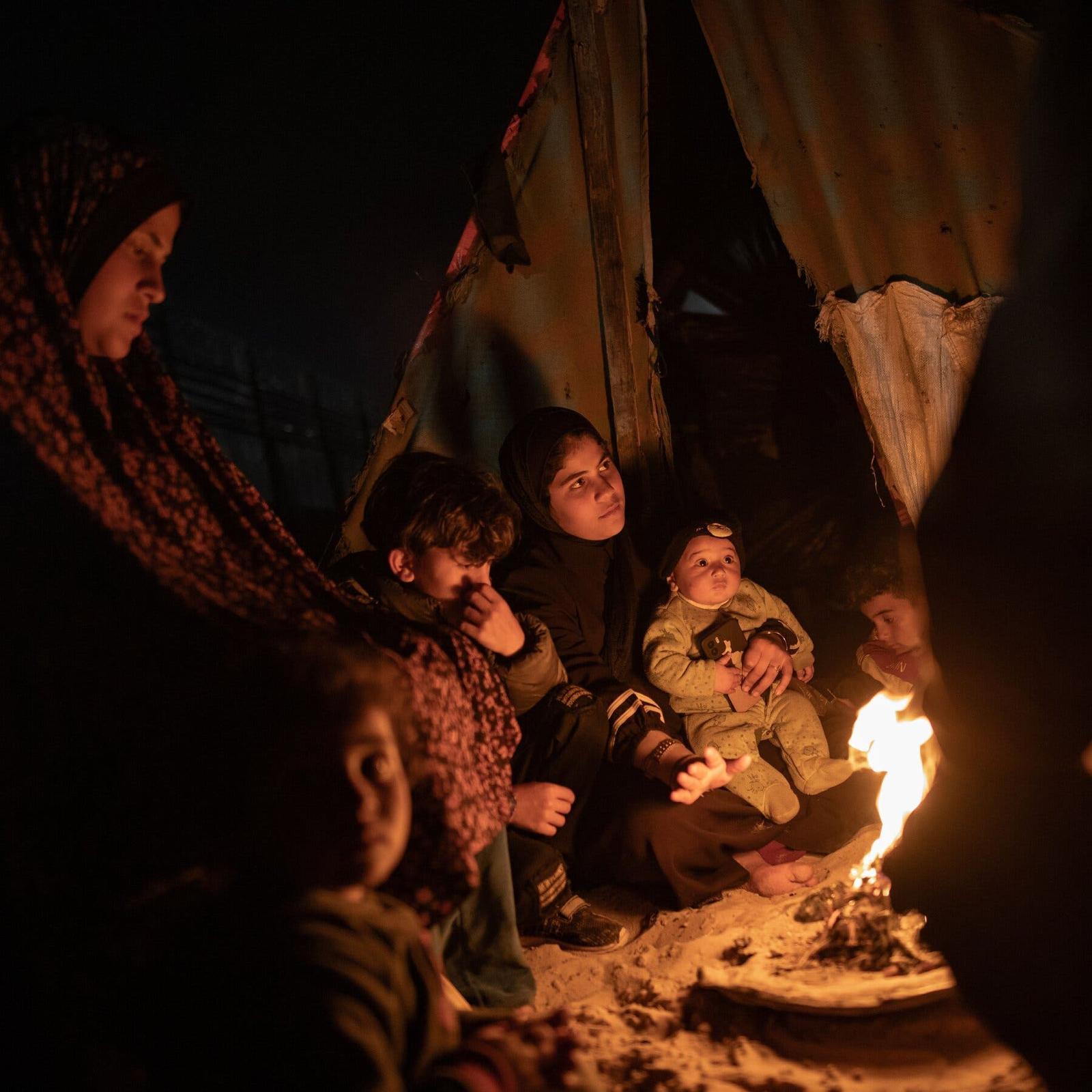
Last week, displaced Palestinian families in Gaza wake up to find water flooding their tents, after heavy rainfall left their shelters and belongings soaked. It is now the third winter they have endured since the start of the two-year Israeli genocide.
Officials in Gaza have received “hundreds of pleas for help,” Mahmoud Basal, the spokesperson for Gaza Civil Defense, said “but the resources are nonexistent.”
“Entire shelter centers have seen water levels rise to more than 10 centimeters (3.94 inches). Mattresses are soaked, blankets are drenched and there are no options left, because every option has been destroyed by Israel,” he said.
The Civil Defense has warned residents, especially the displaced, to take necessary precautions against potential destruction from the storm, with strong winds, heavy rain, and thunderstorms expected over the coming days.
Israel Blocks Tents: What We Know
In the Gaza Strip, families displaced by Israel’s two-year genocide find themselves confronting a relentless, freezing reality: three winters in a row without adequate shelter. As winter approaches once more, the urgency of the situation is palpable, cold nights, battered tents and flood-prone areas.
According to the UN agency for Palestinian refugees, UNRWA, nearly all of the Gaza Strip’s residents have been displaced. Following the start of the ceasefire, many families tried to return to their homes, most to find only rubble.
However, according to the UN Satellite Centre, around 81% of all structures are damaged.
As the ceasefire entered its second month, humanitarian agencies say that far too little aid is reaching Gaza, as hunger persists with winter approaching and old tents start to fray.
The Norwegian Refugee Council (NRC), which hosts the Shelter Cluster that coordinates the humanitarian shelter response and identifies priority needs for displaced families, said that Israeli restrictions continue to block the entry of lifesaving shelter materials.
The NRC noted that since the ceasefire took effect on 10 October, Israel has rejected 23 requests from nine aid agencies to bring in urgently needed shelter supplies such as tents, sealing and framing kits, bedding, kitchen sets, and blankets, amounting to nearly 4,000 pallets.
“We have a very short chance to protect families from the winter rains and cold,” said Angelita Caredda, Middle East and North Africa Regional Director for the NRC.
“More than three weeks into the ceasefire, Gaza should be receiving a surge of shelter materials, but only a fraction of what is needed has entered. The international community must act now to secure swift and unimpeded access.”
According to the humanitarian coordination body, nearly 1.5 million people already required tents and other emergency shelter materials and more than 282,000 housing units have been damaged or destroyed across Gaza, leaving families without protection, privacy, or adequate shelter as temperatures drop.
The Gaza Municipality has also warned that the humanitarian situation in the city could deteriorate sharply with the arrival of winter rains. In a statement, the municipality said any rainfall could worsen the suffering of hundreds of thousands of displaced people living outdoors or in damaged tents, noting that 93 percent of tents have either collapsed or become uninhabitable after nearly two years of war.
Officials cautioned that without an immediate delivery of relief supplies, fuel, and repair equipment, the already fragile sanitation and water systems could completely fail once heavy rains begin, heightening risks of flooding, disease outbreaks, and contamination.
“The tragedy of Gaza’s residents may worsen significantly in the coming weeks unless urgent international intervention is mobilised,” the municipality said, urging humanitarian organisations to act swiftly to prevent a larger catastrophe threatening civilian lives and public health.
UNRWA said 61 million tonnes of debris now cover Gaza and entire neighbourhoods have been erased. It said families were searching the ruins for shelter.
Two weeks ago, the Gaza Rights Center (GRC) confirmed that 74% of the tents currently housing displaced Palestinians are unfit for living.
Last winter, several children froze to death amid a harsh cold snap in Gaza, where a lack of heating was compounded by Israel’s blockade preventing shelter from entering the enclave.
Amjad al-Shawa, director of the Palestinian NGO Network, which liaises with the UN, said: “We are entering winter very soon, which means rainwater and flooding are expected, and there is a high risk of disease outbreaks due to the hundreds of tons of waste near residential areas.”
Is Aid Entering Gaza?
Aid groups and Palestinians say Israel has “engineered starvation” in Gaza.
The Gaza’s Government Media Office has said since the start of the ceasefire, only 28 percent of the agreed-upon number of aid trucks have been allowed to enter, far below the promised 15,600, amounting to 171 trucks per day after the ceasefire.
“These limited quantities fall far below the minimum humanitarian threshold,” the Office said, calling for the immediate entry of at least 600 trucks daily to provide essential supplies such as food, medicine, fuel, and cooking gas.
The Office has also accused Israel of “engineered starvation,” saying Israel has banned more than 350 basic food items, including eggs, meat, cheese, vegetables, and nutritional supplements, while permitting low-value products such as soft drinks, chocolate, and crisps sold at inflated prices.
“This proves that the occupation is deliberately implementing a policy of food manipulation as a weapon against civilians,” the Office has added.
“The UN and its partners have been able to get 37,000 metric tonnes of aid, mostly food, into Gaza since the October 10 ceasefire, but much more is needed, " UN spokesperson Farhan Haq told reporters.
“Despite significant progress on the humanitarian scale-up, people’s urgent needs are still immense, with impediments not being lifted quickly enough since the ceasefire,” Haq said, citing reports from the UN’s humanitarian service, OCHA. Haq was critical that entry of humanitarian supplies into Gaza continues to be limited by Israel.
The UN’s World Food Programme has stressed all crossing points into the Gaza Strip should be opened to flood the famine-hit territory with aid.
Chris Gunness, the former spokesperson for UNRWA, the Palestinian refugee agency, said Israel is committing a war crime by blocking aid to Gaza. Speaking to Al Jazeera, Gunness noted that tens of thousands of Palestinians – mainly children – remain at risk of malnutrition.
He also said that if Israel doesn’t meet its obligation “to flood the Gaza Strip with humanitarian aid”, then third-party countries must act. “Israel has made it clear that it wants to commit a genocide against the Palestinians, it wants to ethnically cleanse them, and it wants to starve them,” he said.
The Norwegian Refugee Council confirmed that only 100 aid trucks are entering Gaza daily through the UN system as the NGO and other humanitarian organisations are “effectively barred” from bringing in desperately needed assistance.
“There may be aid coming in through governments like [the UAE and Egypt] that we don’t have oversight over, but we know the amount of aid that is entering is wholly insufficient for the tremendous amount of need in Gaza after two years of bombardment and destruction,” communication adviser Shaina Low told Al Jazeera.
“We have about $4m worth of aid sitting in warehouses in Egypt waiting to be deployed,” including shelter and hygiene supplies that will be critical for the approaching winter, she added. “But each time we apply with the Israelis, we get rejected.”
Low said even basic tents are a rare commodity for hundreds of thousands of displaced people in war-battered Gaza.
“Many people do not even have tents,” she said. “The people who have tents in Gaza are the ones who are lucky.” “We’re just calling for the entry of emergency shelter supplies like tents, like tarpaulins … which will provide the minimal amount of shelter for the winter,” said Low. “We haven’t even been able to prepare or plan for the long term.”
The World Food Programme noted last month only half the needed amount of food is coming in. Abeer Etefa, senior spokesperson for WFP, described the situation as a "race against time". "We need full access. We need everything to be moving fast," she said.
The ceasefire includes a term requiring Israel to allow humanitarian aid to enter Gaza. Despite this, essential goods still face heavy delays. Residents report that the blockade continues to limit life-saving food and supplies. Last August, the Integrated Food Phase Classification (IPC) officially announced that Gaza is subjected to an Israeli-made famine.