A person is usually born into a community, one life folded into the rhythm of many. But here in Gaza, things have always been different.
We are born not merely into a community, but as a community, as roots pressed deep into the soil of this place. From the summer sea to the winter fire pit, from the spring chrysanthemums to the autumn olive press, Gaza shapes us in every season, in calm and in war, though calm has never truly lived here since the day I opened my eyes to this land.
A Gazan sees themselves reflected in Gaza’s stones, its trees, its sky, even the air that fills its lungs. It is a bond no words can untangle, not even we, who feel it in our bones, can fully describe it.
Here, we cling to our places the way others cling to their children.If the world wouldn’t call us mad, we would list our places among our sons and daughters, answering “three, and a home overlooking Martyrs’ (Al-Shuhada’a) Square” when asked how many we are. But the world has already given us enough labels, and madness would simply be another.
For two years, since October 2023, Israel has harmed us in our children, and in the places we carried like children. Losing a child tears away a piece of the soul; losing both children and places turns a person into a moving shell. Two years of erasure fed on what remained of us.
Today, after two years exiled in southern Gaza, unable to see the face of my own city, I decide to walk toward the scattered pieces of me in the north. They say distance kills love, but Israel has already killed us in every way imaginable, including killing us with longing: longing for those taken, for those we cannot reach, for the places that were our first instinct of belonging. And so I begin my return to Gaza,
by walking the long, wounded length of al-Rasheed Street…
Stepping Into What Was Lost
I step into al-Rasheed Street, the long shoreline road that once threaded the city together like a living artery. Before the genocidal war, this street felt like Gaza’s quiet promise: a place where the sea leaned close enough to touch your breath, where cafés glowed in soft colors at night, and where every passing student, worker, and family carried the calm that only water can give. I used to wait for my university rides just to pass through this road, to watch the waves rise and fall beside the wheels of passing taxis, to catch the faint scent of cardamom coffee drifting from beachfront kiosks, to feel the city open around me in a rare moment of unburdened life.
https://youtu.be/Cb4j0m1voV8?si=E190uo-wgEiXfGMM
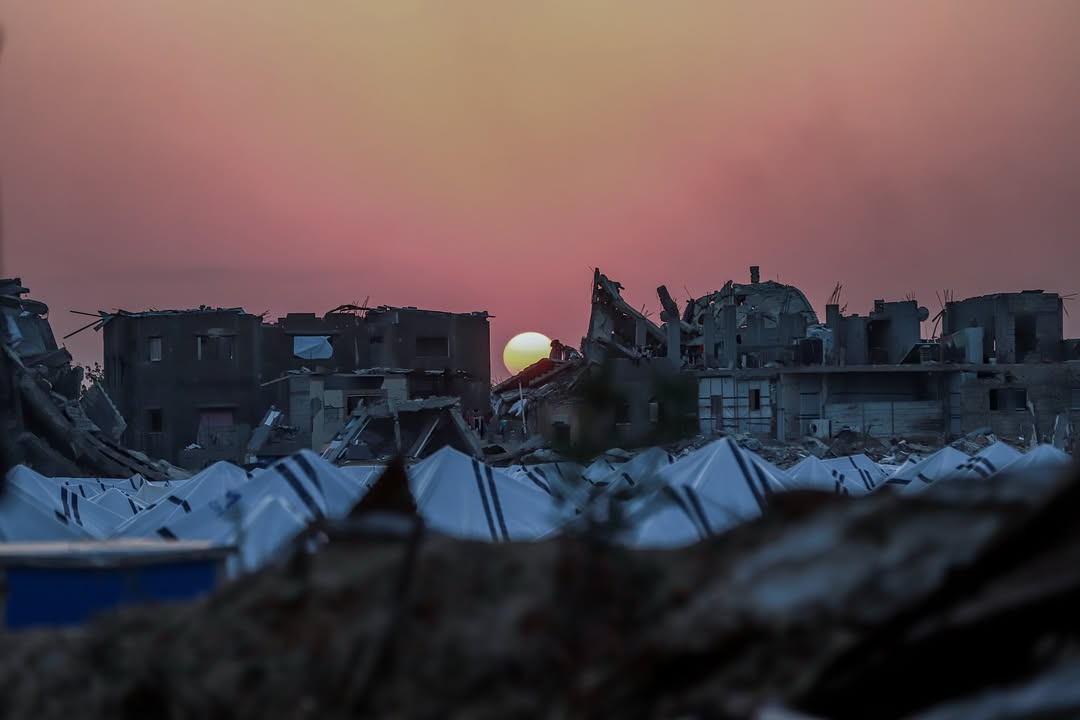
But today, al-Rasheed feels like it has forgotten how to breathe. The cafés are bones. The rest-stops are ash. The sea is blocked by rows of tents, white, torn, heavy with salt and sorrow. A road that once carried the city’s leisure has become the line Israel used to divide Gaza’s body in half: north from south, home from exile.
The driver says nothing, but the radio fills the silence. “Every place longs for you,” an old song for Mohammed Abdu.
The lyrics settle over the ruins outside my window like dust, and something inside me tightens. I close my eyes. For a moment, I hear only the song and the sea, both calling the names of places I haven’t seen in two years.
I open my eyes as the song fades, but the ache it leaves behind lingers like humidity. The car is still moving along al-Rasheed Street, its windows framing a coastline that no longer recognizes itself. The driver keeps his eyes on the road; the radio murmurs low, replaying the line, “Every place longs for you,” as if it were a prayer we are no longer sure how to say out loud.
Beside me sits a man holding a small cardboard box on his knees, filled with socks, batteries, cheap hairclips, and a few small bags of sugar. The kind of mixed, fragile stock that tells you more about survival than any report ever could. I do a double take before I realize I know that I am sitting beside a teacher.
It’s Hussam Hijazi.
Years ago, he was a respected teacher in a school in western Gaza. Now he adjusts the box on his lap so it doesn’t slide with every bump in the road.
He notices my gaze and offers a tired, apologetic half-smile, as if he owes me an explanation for the box between us. “The war pushed me here,” he says quietly, his voice almost drowned by the hum of the engine. “I was a teacher for fifteen years. Fifteen.”
He repeats the number like someone reciting a verse they can’t quite let go of.
“When the schools closed, when salaries stopped, when survival became the only curriculum left… I had no choice.”
He tilts his head toward the window, toward the long line of al-Rasheed stretching ahead of us.
“This was the road I took to school every day,” he adds.
“Now it’s the road I take to find whatever merchandise is cheapest, so I can sell enough to buy bread.”
There is no anger in his tone, only a deep exhaustion, and a thin thread of dignity holding itself together in his posture, in the way he keeps one careful hand on the box as if it were the last fragile shape of his old life.
For a moment, we sit in silence. The car rattles forward. Outside, the tents blur past like a second, makeshift city.
Hussam lets out a short, humorless laugh, and I feel something pull inside my chest, the sense that Gaza has not only displaced its people, but displaced them from the roles they were born to fill.
When the car finally slows near the broken frame of the Palestinian Legislative Council, I step out. The air outside is heavier, but my steps are surer. Some destinations demand the dignity of arriving on foot.
https://youtu.be/OcTNjjcnXG0?si=tmQAWCM-mneQG36-
I close the door behind me, leaving Hussam to continue his search for cheaper goods, and begin walking toward the place that once held this city’s mind and conversation:
Rashad al-Shawa Cultural Center.
Rashad al-Shawa Center: A City Without Its Stage
The closer I get to Rashad al-Shawa Cultural Center, the more the air changes. It becomes heavier, as though grief has density here, as though memory thickens into something you must wade through.
This center was once Gaza’s crown, its intellectual gateway, the hall where international delegations sat, where young people filled notebooks, where exhibitions stretched across polished floors. I attended conferences here, hurried between its doors, listened to voices that dared to imagine Gaza as part of the world.
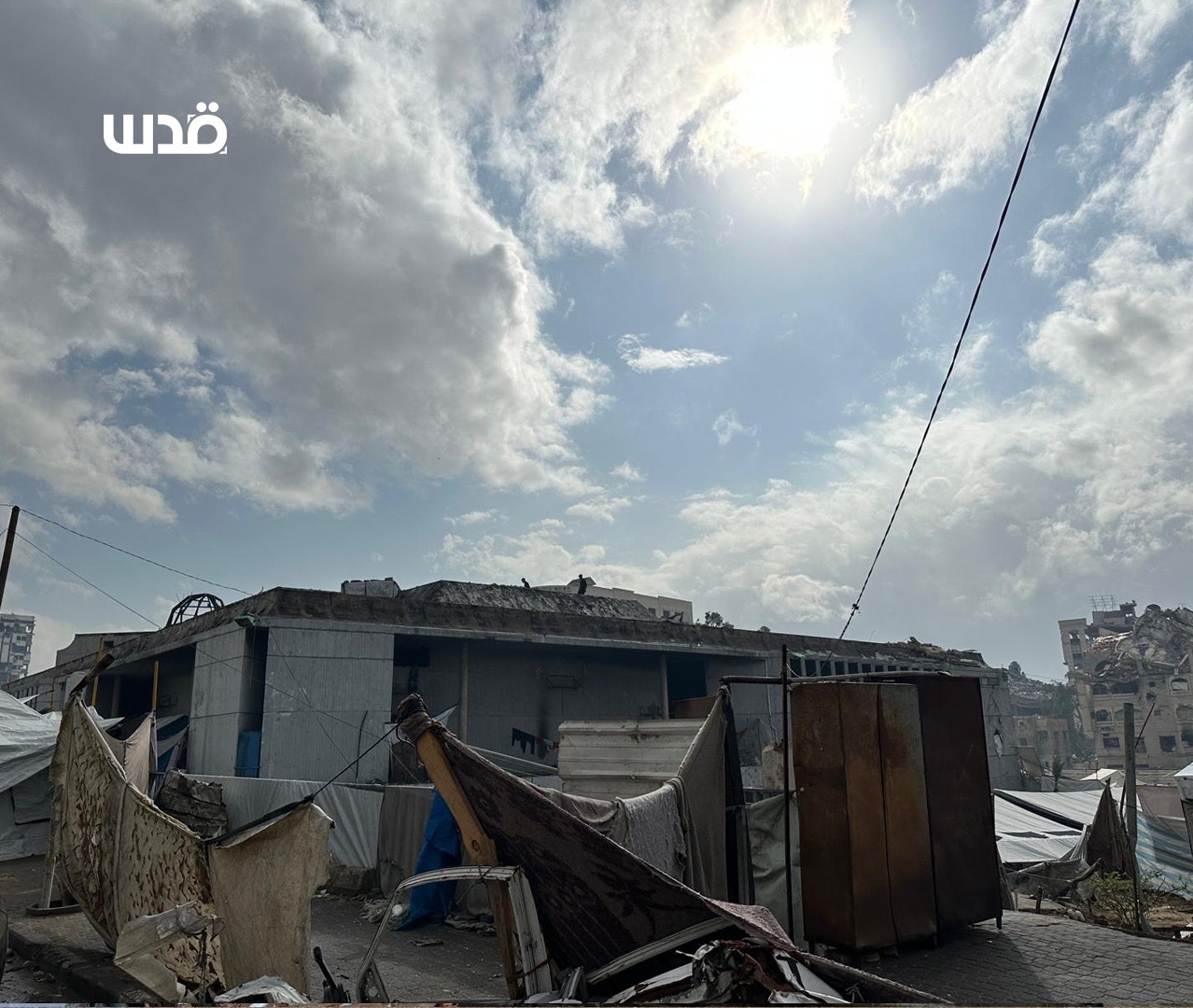
Now, when I stand before it, it takes me a moment to realize I’m in the right place. The great hall is gone. The façade is fractured. And where the entrance once welcomed thousands, there are tents, dozens of them, pitched against walls that survived only halfway.
Inside one of these tents, I meet Abeer Dheifallah, sitting on a thin mattress that barely shields her from the cold ground. She looks at the ruins around her and shakes her head slowly.
“I used to enter this building with awe,” she says. “It made me feel small in a good way, small because Gaza was grand. I never imagined I would be living inside a tent here, in the same place I once entered dressed for conferences and ceremonies.”
Her voice breaks when she adds, “I feel like the center is ashamed of what we have become, or maybe I am ashamed that I have no walls to hide my grief.”
Just beyond the tents stands al-Karmel Secondary School for Boys, directly opposite al-Shawa Center. My father spent years teaching Arabic there, years shaping students who went on to rank among Palestine’s highest achievers in national exams.
Today, the schoolyard is a field of tents. The classrooms are unrecognizable. My father refuses to walk near it; he avoids its name in conversation. He fears that seeing what it has become will pierce through layers of grief he carefully folded away.
And he is not alone. According to updated educational damage assessments, more than 80% of Gaza’s schools have been destroyed or severely damaged, and over 625,000 students lost access to formal education. The numbers are staggering, yet they still feel too small to capture what it means when the place where your father once shaped futures becomes a shelter without books, without teachers, without children.
https://youtu.be/LWQm2UkwfBQ?si=su9LskQ3sQ2-fhcn
I cannot stand here any longer. I turn south, walking toward a place that once tasted like celebration.
Abu al-Saud Sweets, The Sweetness That Tried to Live
The smell reaches me before the storefront does, a memory, not a scent. Warm sugar. Melted cheese. Semolina kissed by heat.
https://youtube.com/shorts/3K-UYzdM8jI?si=HpJC1exZXK3hm_t4
Abu al-Saud, Gaza’s most beloved dessert shop, sits half-rebuilt, half-broken, but undeniably alive. It was tradition: every person passing by would stop for knafeh, whether they planned to or not. It was the dessert people carried abroad as gifts, the taste that said “Gaza” before any word could.
During the first day of the genocide, Abu al-Saud voluntarily shut its doors, not because ingredients ran out, but out of mourning for the martyrs, as the shop’s manager, Khaled Abu Ouda, told me.
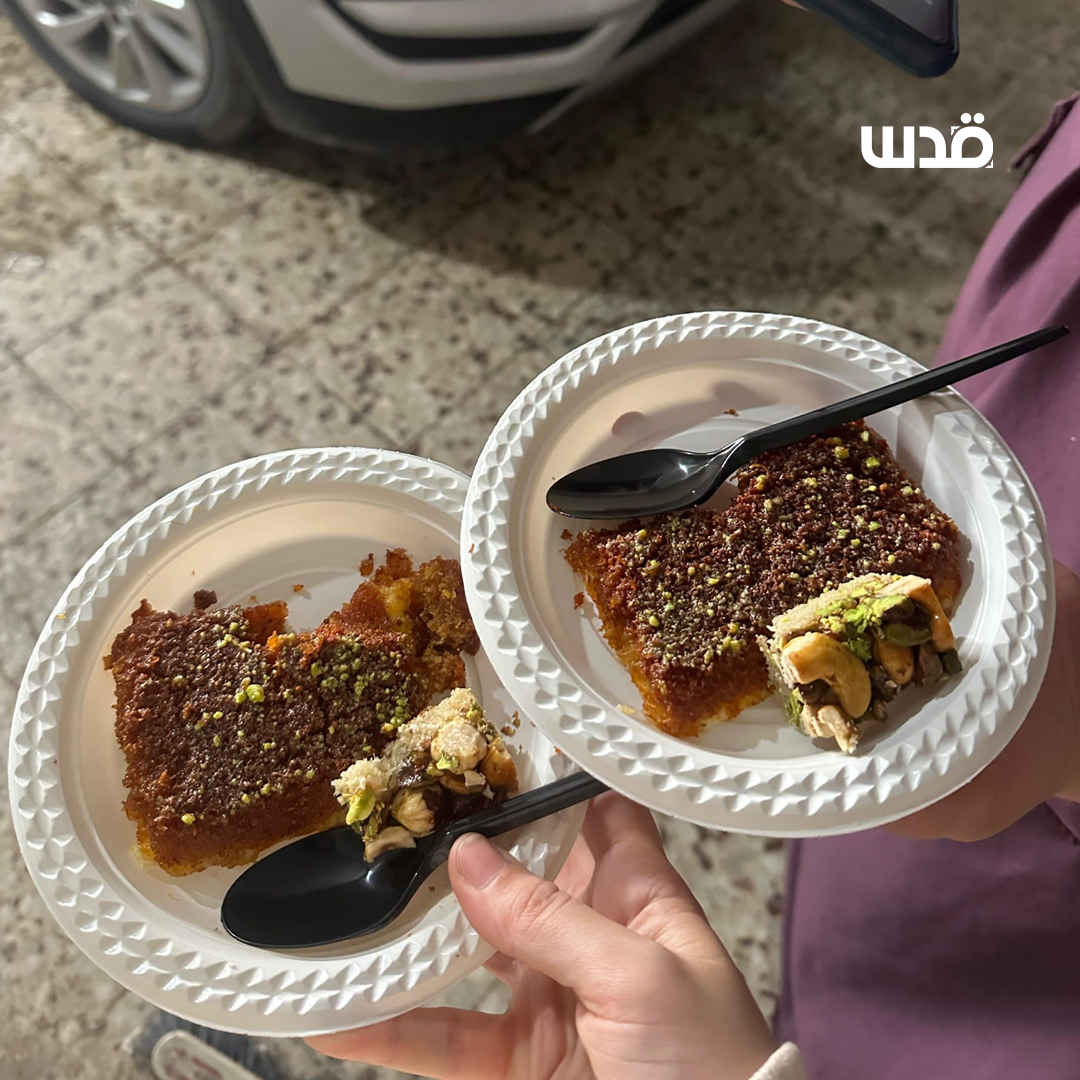
Then came the strike. The ovens were shattered, the counters burned, the copper trays twisted. But the moment a temporary truce was announced, Abu al-Saud reopened. Khaled described it simply:
“When I saw the crowds coming back, more than before, it felt, for a moment, like the war had ended.”
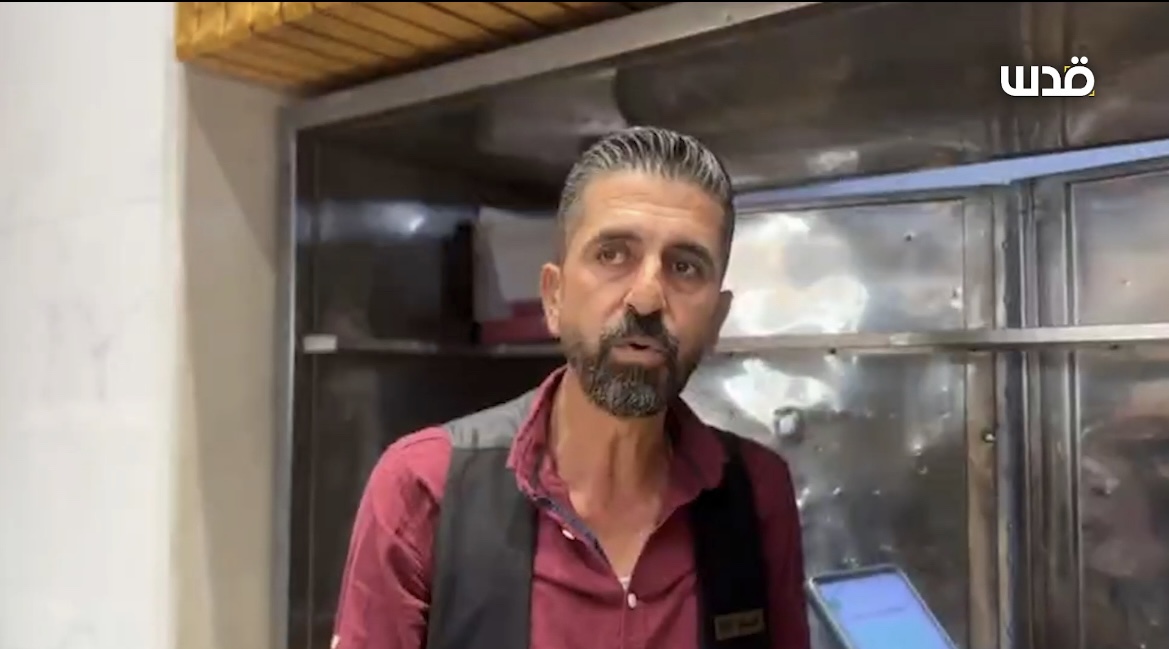
I stand before the shop and feel the ache of something too tender to touch. I cannot enter. Sweetness today feels like a betrayal.
I leave the lingering scent behind and continue walking toward where the city once rested.
https://youtube.com/shorts/L_PxF9jTjSY?si=Oq6-HbA4iOPCPiHW
The Vanishing of Unknown Soldier Square
Saha al-Jundi al-Majhoul, The Unknown Soldier Square, was once the wide breath between Gaza’s errands. The place we stopped to rest after shopping in Rimal. The place we crossed on our way to work. The place we bought Gaza-style iced drinks or kharroub before continuing our day.
https://youtu.be/E65AD37QKJM?si=Gd5r7xlk8wWrn9bc
For a full year of my life, I passed through this square daily as a marketing content writer working nearby.
Today, as I reach its edges, I cannot recognize it. The square is gone,
not metaphorically, but literally buried under tent after tent after tent. There is no room to walk. No pigeons. No vendors spinning pink cotton candy. No children weaving through legs.
Just fabric walls and ropes and exhaustion. And then, quietly, grief takes a new shape inside me. Because from here, I walk toward the building where I worked for the first time, my first job, my first salary, my first steps into adulthood.
I found it collapsed.
The place where I learned how to write professionally, where I grew into myself, where coworkers became friends, gone.
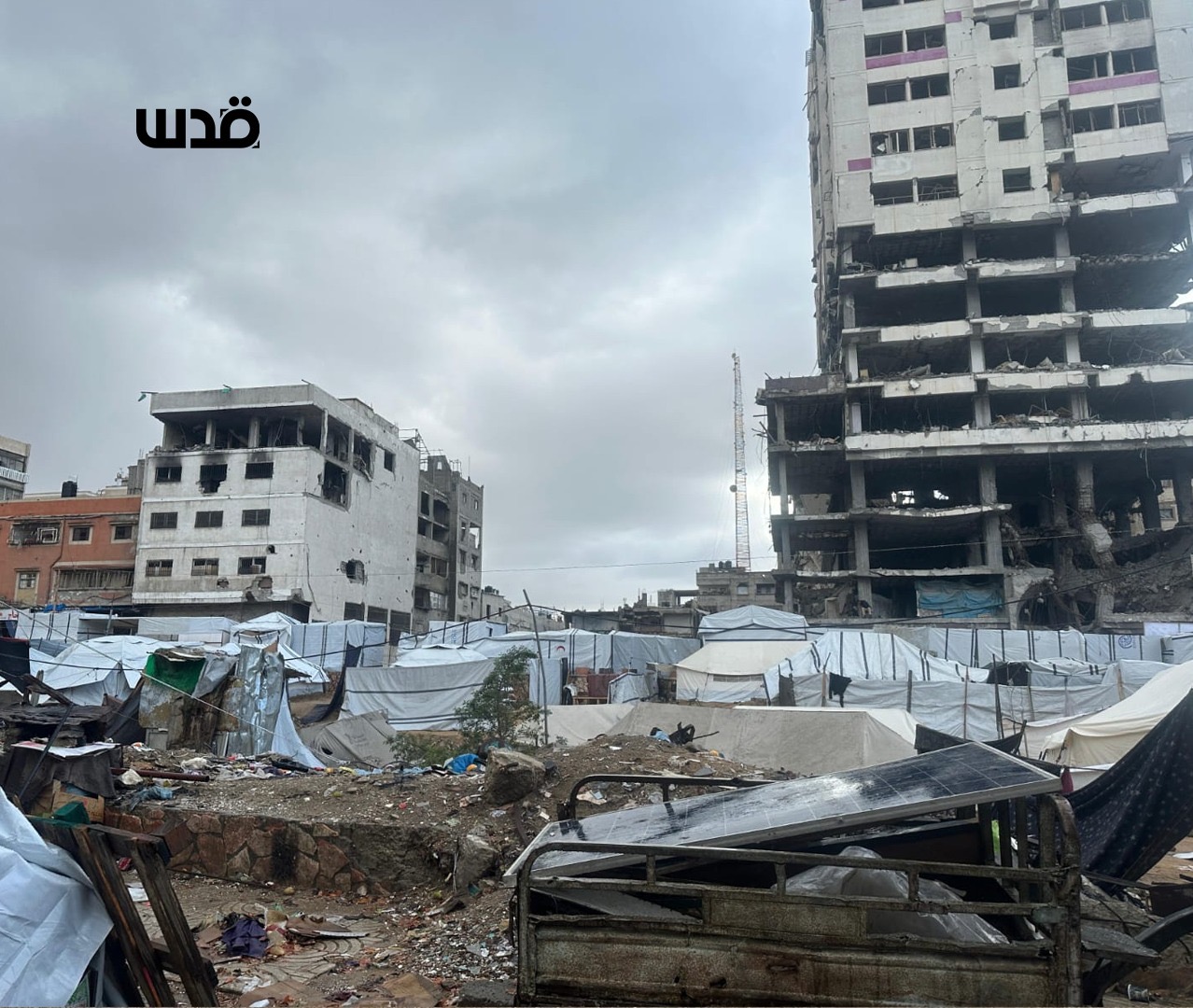
According to recent economic assessments, over 70% of Gaza’s private businesses have been destroyed, and more than 85% of the workforce has lost stable employment. Entire sectors vanished: marketing, IT, media, design, retail, too many to count. These numbers sit heavily on the rubble where my workplace once stood, because now they have a face. Mine.
I can’t stay here.
I continue walking toward a familiar landmark of comfort.
https://youtu.be/Wo4pi23OAzM?si=uMtWMPSWGS7W0Qws
The Last Taste of Normal, Muraṭibat Kazem
For a fleeting moment, I almost smile.
Because Kazem’s Ice Drink Shop, Muraṭibat Kazem, is still operating.
He still accepts the small 10-shekel coin that most shops refuse due to inflation and scarcity. He still uses the same recipe he used before the war. But when I take a sip, something inside me folds.
My taste buds recognize the flavor, but my heart does not recognize the world around it.
Maybe it’s because every place in Gaza carries ghosts now.
https://youtu.be/OdXCNISIFug?si=rx9EvzW1aKr7tR_S
Kazem’s iced drink holds memories of people who are no longer here to drink it with me.
And joy, when tied to faces that war has erased, becomes something sharp rather than sweet.
I leave silently.
Some losses are too loud to swallow.
Returning South, A Road That No Longer Knows Us
The sun begins to sink as I make my way back toward al-Rasheed Street. This time, I walk slowly, unwilling to rush through the city that has already lost too much.
On my way back south, the bus I’m riding in jolts to a stop. A crowd is arguing over space in a small minibus. I look out the window and my breath catches, my former university professor is among them.
Before the war, he drove to campus in his private car, respected, dignified, steady. Today, he is forced to fight for a seat in an overcrowded shared bus, because survival has turned every meter of asphalt into a battlefield.
I turn my face away quickly, pretending not to recognize him, giving him the dignity the war has stolen.
Recent human-impact reports show that more than 60% of Gaza’s academics and university employees have lost their jobs or were forced into informal labor, selling vegetables, repairing shoes, working construction, anything that might keep a family alive for one more week.
He is not alone.
None of us are.
This Pain Has No Ending Yet
As Gaza fades into the darkness behind me, I can feel the weight of everything I saw pressing into my lungs. The tents. The ruins. The places that once held our laughter. The places that raised our parents. The places that shaped who we became.
https://youtube.com/shorts/yQwrEjHcGRs?si=2d_xrZl4bNK0ZffT
We keep telling ourselves we will return to these places when the war ends, but today taught me a different truth:
we are returning even as we are breaking.
This genocide did not only kill people. It killed the geography of our memories. It killed our places, which for Gazans, is another form of killing us.
Tonight, as I arrive back in the south, the nightmare does not loosen its grip. We still wake up from dreams of those we lost.
Now we also wake up from dreams of the streets and buildings that raised us.