

* This report is the fourth part of Silicon Valley Colonialism: The Corporate Empire Behind Israel, an ongoing investigation into how global corporations and tech giants supply the digital and mechanical tools of modern warfare and apartheid. Here, we turn to Amazon; a company whose e-commerce empire, global cloud infrastructure, and artificial intelligence services have become central to Israel’s military, surveillance, and economic domination.
For years, Amazon has expanded its footprint in Israel through AWS data centers, billion-dollar contracts, and partnerships with state and defense institutions. Technologies once promoted as tools for commerce, logistics, and efficiency are repurposed as mechanisms of war and control — the invisible backbone of cloud-enabled targeting systems, predictive policing, and digital apartheid.
From AWS cloud regions to AI-driven logistics and security platforms, Amazon’s systems provide the infrastructure for military operations, mass data collection, and the economic integration of occupation.
The evidence in this report exposes not only the critical role Amazon plays in sustaining Israel’s military and surveillance apparatus but also the corporate complicity that underpins these partnerships. By tracing the company’s contracts, acquisitions, and collaboration with Israeli intelligence, we show how Amazon’s drive for global dominance collides with human rights, how profits are extracted from repression, and how neutrality becomes impossible when technology powers genocide.
This is not just about online shopping or fast delivery. It is about the architecture of empire — where platforms become weapons, clouds become battlefields, and corporations become enablers of systemic violence.
Amazon Inc., founded by Jeff Bezos in 1994, began as an online bookstore and quickly expanded into a vast array of product categories, earning the moniker “The Everything Store.” Its aggressive diversification and reinvestment strategy cemented its status as a transformative force across industries.
As of 2023–2024, Amazon is the world’s largest online retailer and marketplace, a top provider of smart speakers, cloud computing services through Amazon Web Services (AWS), and live streaming via Twitch. It ranks as the second-largest private employer in the United States and is also a global leader in research and development spending.

AWS in Israel: A $7 Billion Military Enabler
Amazon’s Entry into Israel
Amazon entered Israel in 2014 by opening its first research and development (R&D) center, aiming to tap into the “Startup Nation” ecosystem and advanced local talent. In 2019, the company expanded into consumer operations by launching local delivery services, offering products from Israeli brands in local currency.
In 2021, Amazon, in partnership with Google, secured the $1.1 billion “Nimbus” government contract to provide cloud services for Israeli government ministries and public entities. Two years later, Amazon launched the AWS Israel (Tel Aviv) Region with three availability zones, greatly enhancing the occupation state’s cloud infrastructure.
Infrastructure, Investment, and Economic Impact
The AWS Israel Region serves as the cornerstone of Amazon’s local infrastructure. Amazon committed 26.6 billion shekels (about $7.2 billion) between 2023 and 2037 for construction, connectivity, and operations. The investment is projected to contribute 51.7 billion shekels (about $13.9 billion) to Israel’s GDP and support over 7,700 jobs annually.
Amazon also strengthened its presence by deploying CloudFront’s Content Delivery Network (CDN) in Israel.
Reports show that AWS’s cloud powers Israeli military surveillance, storing massive intelligence data on Gaza’s population with “infinite” capacity to track "nearly every individual".
Acquisitions of Israeli Startups
In 2015, Amazon acquired Annapurna Labs, a chipmaker based in Israel, for $370 million. In 2019, it purchased CloudEndure, a cloud computing startup specializing in data migration and disaster recovery, for $250 million. These acquisitions bolstered AWS’s technological portfolio and global competitiveness.
Amazon and Israel’s Military Establishment
The Nimbus project marked a turning point. In 2021, Amazon and Google signed a $1.22 billion deal with the Israeli government to migrate information systems to cloud servers and provide advanced AI and machine learning tools.
These include facial recognition, image classification, object tracking, biometric analysis, and sentiment analysis. Reports show that AWS cloud infrastructure stores vast surveillance data on Gaza’s population—described by insiders as covering “nearly every individual.”
Military testimonies indicate AWS was used to confirm aerial strikes in Gaza, some resulting in civilian deaths. One source said operational orders were carried out using “two screens”—one linked to military systems and the other to AWS, illustrating real-time integration between Amazon’s cloud services and Israeli military intelligence.
Following October 7, Israel increased its reliance on external cloud services, including AWS, under the Nimbus framework.
Global Backlash
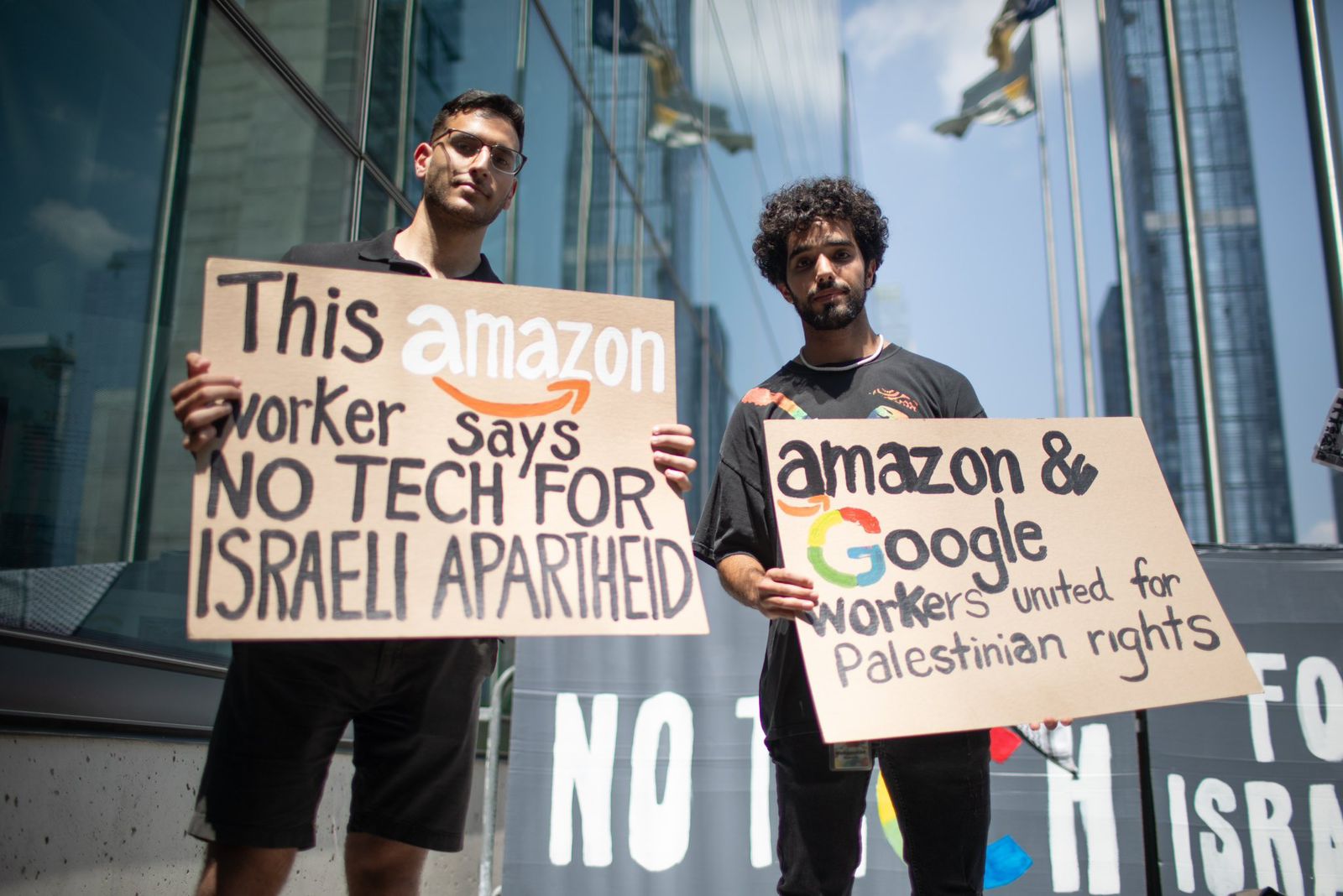
Amazon’s role in Nimbus has triggered protests worldwide. The “No Tech for Apartheid” campaign, led by Amazon and Google employees, demands the contract’s termination, warning it fuels systemic discrimination and apartheid.
The Electronic Frontier Foundation (EFF) raised concerns that Amazon’s AI and cloud technologies are “critical to surveillance operations in Gaza.” A June 2025 UN experts’ report went further, naming Amazon among the companies enabling Israeli targeting systems and destruction in Gaza. Amazon has not directly addressed these allegations.
The contract also contains a clause ensuring service continuity despite boycott campaigns, showing both Amazon and the Israeli government anticipated backlash from the outset.
These factors suggest AWS is not a passive data host but an integrated part of Israel’s intelligence and targeting system, making it indispensable to ongoing military operations.
Human Rights and Corporate Accountability
Amazon publicly commits to embedding human rights principles into its business. Yet its involvement in surveillance, targeting, and strikes in Gaza highlights a glaring contradiction.
The scale of AI-powered surveillance and its use in occupied territories raises profound ethical questions. Critics say Amazon’s refusal to respond transparently undermines its credibility as a socially responsible corporation.
Opposition from employees, human rights groups, and UN experts underscores the depth of these challenges and places Amazon at the center of a global debate about Big Tech’s complicity in genocide.
Amazon boasts that over 45,000 veterans and their spouses are currently employed across a wide range of its operations worldwide.
Employment and Military-Tied Workforce
Amazon actively promotes hiring military veterans and their families worldwide. In Israel, its Tel Aviv office focuses on AWS roles like software engineers, architects, and data scientists. Because military service is mandatory, much of this workforce comes from elite Israeli military units such as Unit 8200.
Even without a specific veterans’ program, Amazon benefits from Israel’s military-trained talent pool, indirectly reinforcing ties between its local operations and the occupation’s military-tech ecosystem.
Amazon’s strategy in Israel combines technological innovation, e-commerce expansion, and cloud dominance. Yet its deep involvement in Nimbus makes AWS a direct enabler of Israeli intelligence and military operations, drawing accusations of complicity in war crimes.
The contradiction between Amazon’s human rights principles and its operational role in Gaza highlights the growing ethical crisis facing global technology giants.