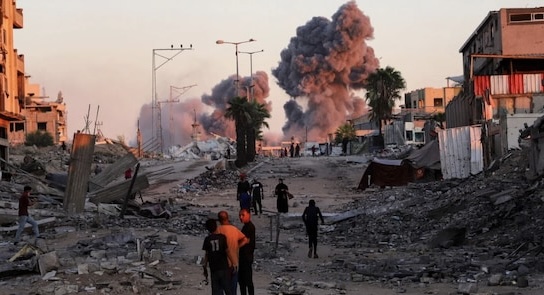
Orange skies in Gaza. Same barbaric scenes on loop. Shame on the world. https://t.co/9fY9Eyg1DT
— Hamza Yusuf (@Hamza_a96) August 24, 2025
ليلة من الجحيم في غزة
— MO (@Abu_Salah9) August 23, 2025
لعن الله الاحتلال، حسبنا الله ونعم الوكيل. pic.twitter.com/Dl33zreBpJ
Everything You Need to Know About Israel's Use of Booby-Trapped Robots in Gaza: Deployment and Destruction Human rights groups, including the Euro-Mediterranean Human Rights Monitor, reported that since May 2024, Israeli forces have been deploying remotely controlled robots packed with explosives in northern Gaza, especially areas like the Jabalia refugee camp. These robots have been detonated in residential neighborhoods, causing widespread destruction and multiple civilian casualties. "In fact, the sound of the explosion was actually louder than the sound of air strikes, to the point that white dust covered the entire area," one Gaza resident said. "It was subsequently discovered that this explosion was caused by a robot equipped with tons of explosives, destroying roughly six or seven houses at once." Scale of Destruction Residents and observers report staggering levels of damage: single explosions leveling six or seven houses at once, creating destruction zones extending up to 100 meters fully, with partial damage reaching up to 300 meters. Psychological Impact The explosions are described as shockingly powerful, some say louder than airstrikes, and create a terrorizing atmosphere. A Gaza resident characterized the effect as similar to an “earthquake,” while others described lasting trauma, lost sleep, and constant fear. Gaza civil defence spokesman Mahmoud Bassal said last week, “Within a 100-metre radius, they cause complete destruction, and within a 300-metre radius, they cause partial destruction.” “They have been used extensively in the Gaza Strip during all military operations, particularly in the northern Gaza area, and are now being used in Al Zeitoun neighbourhood.” Bassal said more than 50 robots had been detonated in Al Zeitoun alone, and that they were responsible for the greatest number of homes destroyed in the southern district. “From August 6 until now, the occupation has destroyed more than 500 houses in the Zeitoun neighbourhood through a combination of robot detonations and missiles,” he said. “We can distinguish the explosion of a robot from others because of its destructive power, its extremely loud and terrifying sound, and the large amount of red flames it produces, sometimes lighting up the entire area.” “By blowing up large areas at once, they cause shock and widespread structural collapse, which is intended to demoralise the population and act as a form of deterrence, as part of the military’s ‘geographic engineering’ strategy,” Rami Abu Zbida, a Palestinian researcher on military and security affairs, said. Tactics and Evolution Abu Zbida said Israel was using two types of robots in Gaza, with their first recorded use having been in May 2024, during the assault in Jabalia. “The first type consists of tracked vehicles that have been converted to operate without a crew inside. The most notable of these is the old M113 armoured personnel carrier, which is loaded with tonnes of explosives and remotely driven, then detonated remotely amid buildings before infantry forces advance,” Abu Zbida told The National. The second type of robot is smaller, used either for removing explosive devices or carrying smaller explosive payloads, he said. “These are deployed inside alleyways, buildings or tunnel entrances, loaded with explosive charges or barrels, or used to place directed demolition charges. Reports broadcast by Israeli media, as well as our own monitoring, show that these too are remotely operated inside densely populated areas, and their explosions can destroy a large number of homes at once.” Legal and Humanitarian Concerns Euro-Med said Israel's use of booby-trapped robots is prohibited under international law, as they are considered indiscriminate weapons that cannot be directed or limited to military targets. Their use in residential areas "is a crime against humanity in and of itself", the rights group said.Gaza City right now, 1 am, as Israel is mercilessly pummelling the city ahead of the invasion. pic.twitter.com/LCw87MoM6s
— Abubaker Abed (@AbubakerAbedW) August 23, 2025