1992: The Countdown Begins
In a speech to the Knesset, Netanyahu warned that Iran was “three to five years” away from developing a nuclear bomb.
Five years later? No bomb.
1995: In Print, with a Deadline
In his book Fighting Terrorism, Netanyahu doubled down:
“The best estimates at this time place Iran between three and five years away from possessing the prerequisites required for the independent production of nuclear weapons.”
The prediction pointed to the year 2000 as a likely endpoint. But the new millennium came and Iran’s nuclear program remained non-military.
1996: Testifying Before Congress
Speaking before the US Congress, Netanyahu escalated the warnings:
“If Iran were to acquire nuclear weapons, this could presage catastrophic consequences…”
Yet by the early 2000s, Iran’s nuclear program remained heavily monitored, and inspectors found no active weapons development.
2002–2005: Iraq First, Iran Next
During the lead-up to the US invasion of Iraq, Israeli leaders, including Netanyahu, supported the push for regime change under the pretext of weapons of mass destruction. Iran remained in the background, with occasional warnings resurfacing about its nuclear intent.
Still no nukes. But plenty of headlines.
2009–2012: The Cartoon Bomb Evidence
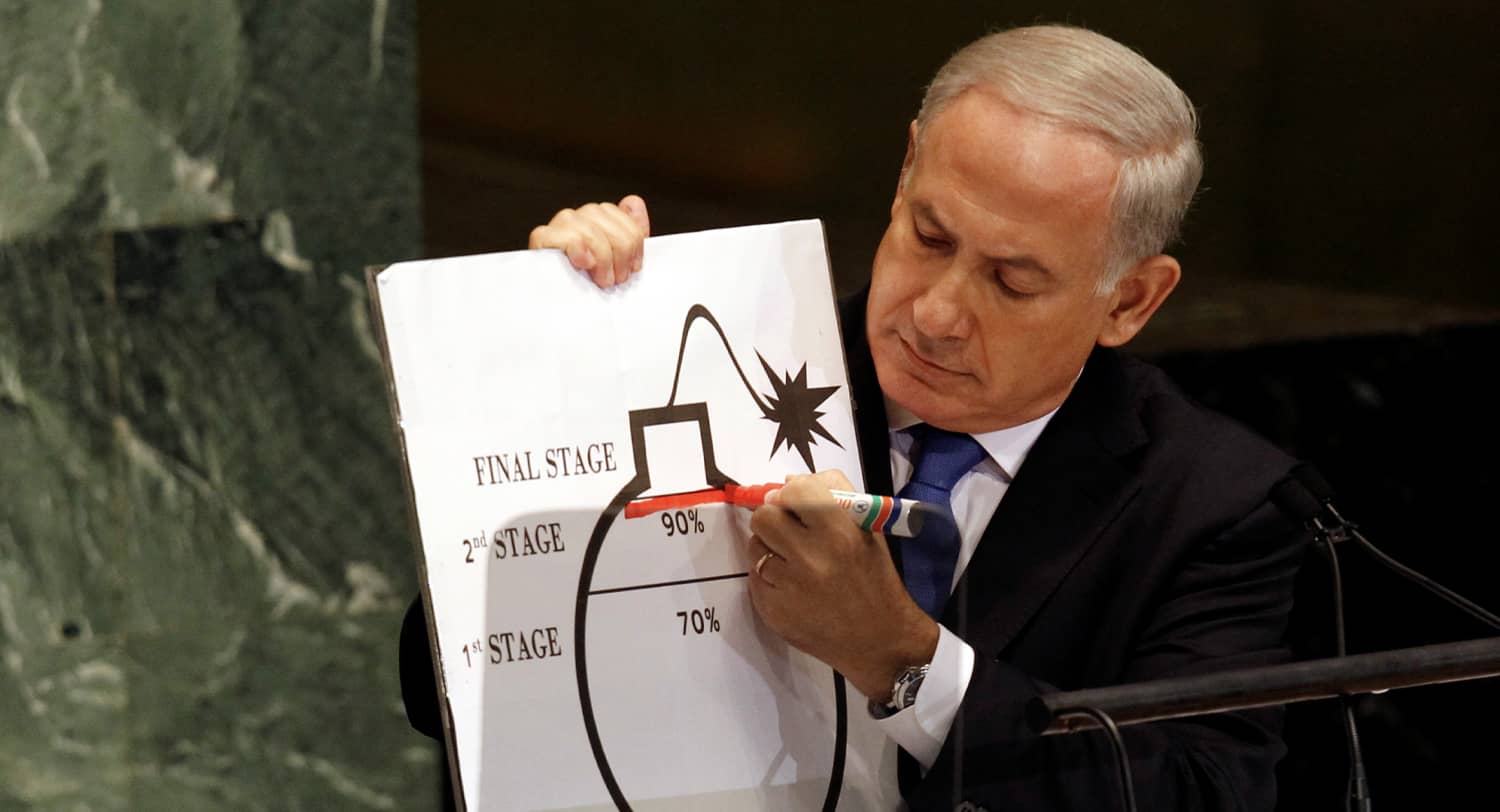
In one of his most memorable performances, Netanyahu appeared at the 2012 UN General Assembly with a cartoon diagram of a bomb.
“By next spring, at most by next summer… they will have finished the medium enrichment… only a few months, possibly a few weeks before they get enough enriched uranium for the first bomb.”
The image went viral but the uranium did not. The red line he drew was never crossed.
2015: The Nuclear Deal He Called a “Historic Mistake”
When Iran signed the Joint Comprehensive Plan of Action (JCPOA), Netanyahu rejected it outright.
“This deal… paves Iran’s path to the bomb.”
In contrast, US, EU, and UN inspectors found that the deal significantly slowed Iran’s nuclear program. But Netanyahu insisted military pressure, not diplomacy, was the only answer.
2020s: Back on the Brink
Upon returning to office in 2022, Netanyahu revived his favorite talking point.
“Iran is on the cusp of nuclear breakout.”
“They could go nuclear in a matter of weeks.”
Weeks turned to months. Then years. Again.
2025: Bombs Away
In June 2025, Israel launched a wave of airstrikes against Iranian targets under “Operation Rising Lion.”
Netanyahu claimed Iran had enough enriched uranium for “nine atomic bombs.”
“We are acting to prevent Iran from developing nuclear weapons.”
However, intelligence reports from the US and IAEA offered no public confirmation that Iran was actually building a weapon.
A Pattern with a Purpose?
After more than three decades of similar warnings, many observers say Netanyahu’s nuclear alarm bells may serve broader political and military goals.
Rather than responding to a real-time nuclear threat, Netanyahu’s long-running campaign may be about:
•Maintaining Israel’s regional military dominance
•Justifying pre-emptive strikes and prolonged military campaigns
•Securing US political and financial backing
•Deflecting attention from Israel’s own undeclared nuclear arsenal (estimated at 80–90 warheads)
Middle East analyst Liqaa Maki put it bluntly: “The target from the very beginning was not just Iran’s nuclear program; it was Iran as a state and the regime itself. The nuclear file is merely a pretext. The real goal is to see Iran divided and weakened as part of the ‘New Middle East.’”