Amazon Supplied Cloud Services to Israeli Bombmakers During Gaza Genocide, Report
Occupied Palestine (QNN)- Amazon has sold cloud-computing services to two major Israeli weapons manufacturers whose arms were used in the Gaza genocide, according to internal company materials obtained by The Intercept.
The report exposes Amazon Web Services’ (AWS) ongoing business with Rafael Advanced Defense Systems and Israel Aerospace Industries (IAI); both central to Israel’s weapons production and military campaigns. The data shows that Amazon continued supplying them with cloud software in 2024 and 2025, during Israel’s genocide in Gaza.
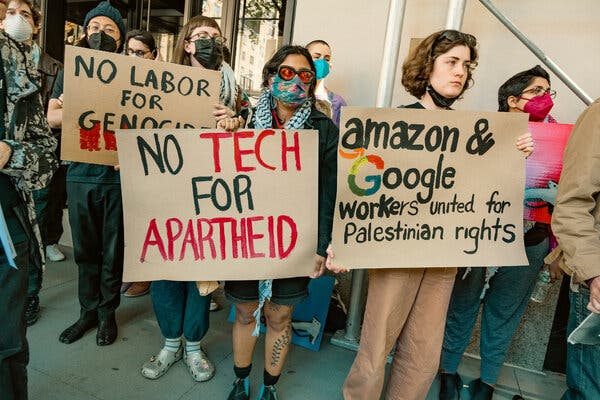
Since 2021, Amazon has been part of Project Nimbus, a $1.2 billion cloud-computing deal with the Israeli government, alongside Google. The agreement provides advanced data storage and processing services to Israeli ministries, including the military and intelligence agencies.
Internal financial documents reviewed by The Intercept show that Rafael and IAI have used Amazon’s technologies, including artificial intelligence tools and large language models such as Claude, developed by AI startup Anthropic.
Amazon also supplied services to Israel’s nuclear program and to offices administering the occupied West Bank, areas where settlement expansion and military control violate international law.
Rafael and IAI are key suppliers of bombs, missiles, and drones used in Israel’s genocide in Gaza. Their technologies include the SPICE guidance kits, which turn regular bombs into precision-guided munitions.
In September 2024, Israel bombed a refugee camp in southern Gaza, a site previously designated as a “safe zone.” Weapons experts later identified fragments of a 2,000-pound SPICE-guided bomb in the rubble. The strike killed at least 19 civilians, including women and children, and was condemned by the United Nations as “unconscionable.”
In another attack in December 2024, the same type of bomb killed 12 Palestinians in central Gaza.
Rafael’s CEO, Yoav Turgeman, boasted in 2024 that the company had achieved “record revenues” during what he described as “the longest and most complex multi-front war in Israel’s history.”
IAI, co-developer of Israel’s Iron Dome system, has also promoted its Heron drones for their role in Gaza assaults. These drones provide real-time intelligence and support precision targeting, capabilities that have contributed to large-scale civilian deaths.
Amazon publicly claims to uphold international human rights standards. Its website states that the company “assesses and responds to risks across the company” and conducts “human rights impact assessments.”
Yet the company declined to answer The Intercept’s questions about whether such assessments were performed before selling services to firms linked to a genocidal war.
Rafael, IAI, and Israel’s Ministry of Defense also refused to comment.
While exact figures remain unclear, the documents indicate Amazon sold services to Rafael at a discounted rate. A 35% discount was reportedly given to the Israeli Ministry of Defense, a key Project Nimbus customer, though it is unknown whether Rafael and IAI received the same benefit.
According to The Intercept, Rafael used Amazon’s Bedrock platform to access generative AI tools, including Amazon’s Titan G1 model and Anthropic’s Claude. This raises questions about compliance with Anthropic’s own policy, which bans the use of its AI for designing or developing weapons.
Amazon also provided Israel’s Ministry of Defense access to Rekognition, its facial-recognition software, for an open-source intelligence project under the Israeli military’s Central Command. Rekognition can detect faces and even read emotions, such as “fear.”
Documents also show that Israel’s Unit 9900, a geospatial intelligence division involved in planning Gaza strikes, used Amazon’s services.