
A City of Deep Roots
Gaza dates back to the Canaanite era around the 15th century BCE. Archaeological sites such as Tell es-Sakan show continuous human settlement since 3300 BCE. The pharaohs called it “Ghazzatu.” The Assyrians knew it as “Azati.” Crusaders named it “Gadres,” and Arabs settled on the name “Gaza.” Some scholars link the word to strength, while others say it means “the distinguished.” Arab historian Yaqut al-Hamawi wrote that to “ghazza” someone was to honor them above others. Gaza’s very name carries meaning tied to resilience.Strategic Location
The city lies on the southern edge of the Levantine coast. It sits 78 kilometers southwest of the occupied Palestinian capital city, Jerusalem, and stretches over 56 square kilometers. Gaza’s position on the Via Maris, the ancient trade route linking Egypt and the Fertile Crescent, made it a gateway for armies and merchants. This location explains why so many conquerors fought to control it. Egyptians, Philistines, Assyrians, Persians, Greeks, Romans, Byzantines, Arabs, Crusaders, Ottomans, and finally the British all claimed Gaza.Gaza in World History
In 332 BCE, Alexander the Great besieged Gaza for two months before capturing it. During the Roman period, Gaza flourished as a wealthy trading hub with a senate of 500 members. Byzantine rulers later turned it into a Christian center, earning the nickname “Athens of Asia.” Islamic armies led by Amr ibn al-‘As entered Gaza in 637 AD, and it became a vital Islamic town. The Crusaders seized it in 1100, only to lose it to Saladin less than a century later. By the 16th century, the Ottomans governed Gaza through the powerful Ridwan dynasty. In 1917, British forces occupied the city from the Ottomans. In 1948, thousands of Palestinians expelled by Zionist militia from their homes and land, to create ‘Israel’, found refuge there after the Nakba.Modern Gaza and Resistance
Gaza has long stood at the center of Palestinian resistance. During the British Mandate, it was a hub of protest. Later, it became a frontline against Israeli occupation. Former Israeli Prime Minister Yitzhak Rabin, a Nobel Peace Prize laureate, once said he wished “the sea would swallow Gaza,” a remark that reflected Israel’s deep-rooted hostility toward the city. Israel first occupied Gaza in 1967. The city became a focal point of the First Intifada in 1987, when neighborhoods like Shujaiya erupted in clashes. After the Oslo Accords, Israel pulled out of Gaza’s center but built settlements around it. In 2005, Israel withdrew its settlers but imposed a land, air, and sea blockade that continues today.The Genocide
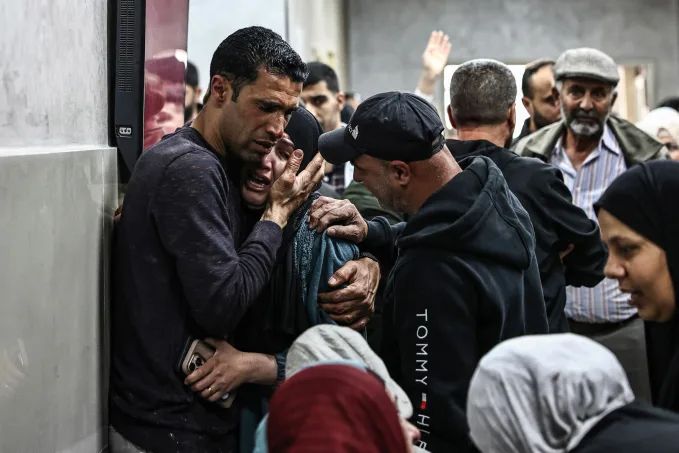
On October 7, 2023, Palestinian resistance launched Operation Al-Aqsa Flood in an attempt to break a 7-year-old Israeli siege. Israel responded with its most destructive campaign yet, announcing its intention to ethnically cleanse Gaza. Entire neighborhoods were flattened. Shujaiya, al-Rimal, al-Tuffah, and al-Zaytoun were reduced to rubble. The Baptist Hospital massacre on October 17 killed more than 500 civilians, mostly women and children. Al-Shifa Hospital, Gaza’s largest medical complex, was stormed twice, leaving hundreds dead and its wards destroyed. Markets, mosques, churches, schools, and even historic sites were targeted. The Church of Saint Porphyrius and the ancient Hammam al-Samra were both struck. No corner of the city was spared.Daily Life Under Siege
Before the blockade, Gaza thrived as an economic center. It exported citrus, olives, strawberries, and flowers. Its factories produced textiles, furniture, soap, and glass. Tourism along the Mediterranean provided jobs. Fishermen supplied Gaza’s markets with fresh catches. But since 2007, Israel’s siege has strangled the city. Industries collapsed. Farmlands were bulldozed. Exports stopped. By 2024, unemployment and poverty reached record levels. Families relied on aid to survive, while students studied by candlelight. Still, Gaza’s culture survived. Its mosques and churches, its embroidery and poetry, and its neighborhoods like al-Shati refugee camp remained symbols of resilience.Cultural Landmarks
Gaza is rich in heritage. The Great Omari Mosque is one of Palestine’s oldest mosques. The al-Sayyid Hashim Mosque contains the tomb of the Prophet Muhammad’s great-grandfather. Al-Shifa Hospital, built in 1946, became the city’s main lifeline in wars. Even under bombardment, these landmarks remind Palestinians that Gaza is more than rubble. It is history carved in stone.A City That Refuses to Die
As Israel repeatedly announced its plan to erase Gaza City and force its more than one million residents to move south or face death, the city’s destruction is reported as if it were ordinary daily news.
To Palestinians, this framing is unbearable. How can the destruction of one of the world’s oldest cities, a place older than Rome or Athens, become routine? Gaza is not only a battleground of the present. It is a living link to 5,000 years of human history. Destroying it would not just erase Palestinian life. It would rob humanity of one of its oldest cities.